

Choosing between ASTM A106 vs API 5L is not a question of which specification is better. The two documents were written for different jobs. ASTM A106 describes seamless carbon steel pipe for high-temperature service in process plants, while API 5L describes line pipe for moving oil and gas along a route. A buyer who needs one of them can rarely substitute the other safely, even when both are offered in the same outside diameter and the same nominal wall thickness.
The overlap is what causes trouble. Both are carbon steel, both can be seamless, both use the same dimensional system, and both arrive with a mill test certificate. This article compares ASTM A106 vs API 5L on what each document actually covers, how the grade systems differ, what the testing clauses demand, and where each one belongs in a real project. It closes with the wording to put on an inquiry and the errors that most often turn into a rejected delivery.
What the ASTM A106 Scope Really Covers
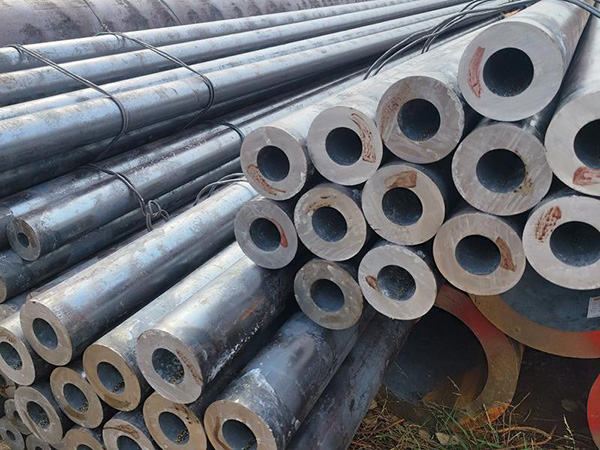
ASTM A106 is a specification for seamless carbon steel pipe intended for high-temperature service. Its scope runs from NPS 1/8 through NPS 48, in three grades: A, B and C. Wall thickness is not fixed by the specification text; it follows the schedule tables of ASME B36.10M, which is why an ASTM A106 seamless steel pipe is ordered as a size plus a schedule rather than as a bare wall dimension.
Because the pipe is seamless, it has no longitudinal weld. The mill starts from a solid billet, heats it to roughly 1200 °C, pierces it into a hollow shell, and then either hot rolls or cold draws it to final dimensions. Cold drawing gives tighter dimensional control and a smoother surface than hot rolling, at a higher processing cost. Both routes produce pipe that satisfies the same specification.
The document is not only a chemistry sheet. It requires tensile, bend and flattening tests, and it requires either a hydrostatic test or a non-destructive electric test before shipment. That combination is what makes A106 the default for steam, condensate, hot oil and similar duties inside a plant battery limit. It is a pipe specification only: wrought fittings are covered by ASTM A234 and forged components by ASTM A105, so a line cannot honestly be described as "all A106" once elbows and flanges enter the picture.
What API 5L Covers
API 5L is the line pipe specification. It exists to move fluids from one facility to another: crude, refined product, natural gas, injection water. The 46th edition is the current baseline version of the document, and it covers both seamless and welded pipe, which is a decisive difference from A106. An API 5L seamless line pipe order can legitimately be supplied as ERW, LSAW or SSAW pipe as well as seamless, and the certificate will name the product form.
API 5L splits its requirements into two product specification levels. PSL1 is the base level, essentially a dimensional and mechanical minimum. PSL2 adds mandatory additional testing together with tighter control of chemistry and traceability, and for many grades it brings notch toughness testing into the order whether or not the buyer asks for it separately. The practical consequence is that "API 5L" written alone on a purchase order is an incomplete instruction; the PSL level changes what the mill must do and what the buyer pays.
Grades are the second difference. API 5L identifies line pipe by minimum yield strength, and the number in a designation such as X42 or X70 is that strength expressed in thousands of pounds per square inch. A higher number means a higher strength pipe that can hold a given design pressure on thinner wall, which is why long transmission lines are built from the upper grades. Lower grades remain common on distribution and gathering work where wall thickness is driven by handling loads and corrosion allowance rather than by pressure alone.
Where the Two Specifications Overlap
The overlap is real and it is the source of most procurement errors. Both documents use the ASME B36.10M dimensional system, so a 12 inch NPS pipe of a given schedule has the same outside diameter and nominal wall whether it is ordered to A106 or to API 5L. Both can be supplied seamless. Both are carbon steel. Both are pressure tested at the mill, and both arrive with a certificate listing heat number, chemistry and mechanical results.
What overlaps least is intent. A106 answers the question of whether a pipe will hold up in hot process service at design conditions. API 5L answers whether a pipe can carry a defined fluid at a defined pressure over a defined route, and whether the resulting line can be welded and inspected in the field. Those are different questions, and a certificate that satisfies one does not automatically satisfy the other. A purchaser who compares only diameter, wall and price is comparing the parts of the two documents that happen to look alike.
ASTM A106 vs API 5L: Key Differences
Service intent: A106 is written around high-temperature process piping; API 5L is written around transportation of fluids through a pipeline system.
Grade logic: A106 uses the letters A, B and C tied to tensile and yield ranges; API 5L uses the X designation tied to minimum yield strength.
Quality levels: A106 has a single requirement set; API 5L has PSL1 and PSL2, and the two carry materially different testing obligations.
Product form: A106 is seamless by definition; API 5L covers seamless, ERW, LSAW and SSAW pipe.
Toughness: A106 does not make impact testing a routine part of every order; PSL2 line pipe commonly does, which matters on low-temperature or high-consequence lines.
Tolerances: the two documents set their own wall, diameter, length and straightness limits, so pipe that is acceptable under one may sit outside the tolerance of the other.
Design code fit: process piping codes list ASTM materials and expect A106 in hot service, while pipeline codes expect API 5L. Substituting across that boundary creates a documentation problem even when the steel itself is adequate.
The last point deserves emphasis. A design code does not merely describe a pipe; it defines which specifications the designer is allowed to select and how the allowable stress is derived. Switching the specification after the stress calculation has been issued is a change to the design basis, not a purchasing convenience, and it usually requires the calculation to be reissued.
Choosing by Service, Not by Price
For piping inside a plant boundary, the answer is almost always ASTM A106. Steam headers, condensate return, hot oil circuits, utility stations and reactor feed lines are designed to a process piping code that expects a listed ASTM material with a high-temperature rating. Grade B is the workhorse; grade A is used where forming or welding demands softer stock, and grade C where higher strength is needed at temperature. Seamless supply also removes the seam as a corrosion and inspection variable, which is why it dominates small-bore and high-pressure work. Where both documents are quoted at the same size, the seamless steel pipe range is the sensible place to compare like with like.
The ASTM A106 vs API 5L question usually settles once the governing design code is known. For a buried or cross-country transmission line, the answer is API 5L, and the interesting decision is the grade and the PSL. Use the criteria below as a starting screen:
Fluid and temperature: hot process fluid above the range where line pipe is normally applied points to A106; ambient-temperature hydrocarbons over distance point to API 5L.
Governing code: if the line is designed as process piping, specify A106; if it is designed as a pipeline, specify API 5L.
Strength versus wall: if pressure requires thick wall at a low grade, compare a higher X grade with a thinner wall before fixing the specification.
Consequence of failure: high-consequence or low-temperature lines justify PSL2 with defined toughness rather than PSL1.
Field welding: long lines with many girth welds favour line pipe, because the grade system, ovality and end tolerances are built around field alignment.
Availability of form: diameters beyond the seamless range can only be met by welded line pipe, which settles the question without further debate.
What to Write on the Inquiry and the Drawing
Specification and edition, for example ASTM A106 or API 5L 46th edition, never just "carbon steel pipe".
Grade, written in the correct notation for that document: A106 Grade B, or API 5L X52.
PSL level for any API 5L item, stated explicitly as PSL1 or PSL2.
Size, schedule and length, with the dimensional standard named so there is no ambiguity about tolerances.
End finish: plain end, bevelled end with the bevel angle, or threaded and coupled.
Test regime: hydrostatic or non-destructive electric test, plus any supplementary impact test, hardness limit or third-party witness point.
Surface protection and marking: coating type, end protection, and the marking and certificate requirements for the shipment.
Two of these items cause most of the arguments. The PSL level is frequently left to the supplier's assumption, and the test regime is frequently copied from a previous project that had different service conditions. Both are cheaper to correct on the inquiry than after the pipe is loaded.
Common Mistakes That Cause Rejections
Treating X42 as an A106 Grade B substitute. The two are close in strength on paper, but they belong to different documents with different testing and tolerance clauses. A third-party inspector working to the process code can reject the substitution even if the pipe performs.
Leaving PSL unstated. The mill quotes the cheaper level, the buyer expects PSL2 documentation, and the gap is discovered at the witness point.
Mixing pipe and fitting specifications. An A106 pipe run welded to A234 fittings is correct; an "A106 elbow" is not a thing, and asking for one signals an incomplete specification to any experienced supplier.
Assuming a higher grade is always safer. Stronger line pipe brings welding procedure implications: preheat, heat input and hydrogen control all become more demanding, and an unqualified procedure can produce cracks that pass a visual check.
Buying on wall thickness alone. Two pipes with the same nominal wall can differ in allowable tolerance and in minimum wall, which changes the calculated pressure rating of the installed line.
Frequently Asked Questions
Can API 5L pipe be used instead of ASTM A106 for steam service?
Only with the agreement of the designer and the authority governing the installation. Steam service is designed as process piping, and the applicable code lists the material specifications it accepts along with the allowable stresses at temperature. API 5L grades can be technically suitable steels, but the substitution changes the design basis and the documentation package. In practice, the cost of re-approval exceeds any saving on the pipe, so most projects keep A106 for hot process lines and reserve line pipe for transport duty.
Is A106 Grade B the same as API 5L X42?
No. They are often mentioned together because their strength levels sit close to one another, but the designations come from different documents. A106 Grade B is a letter grade in a high-temperature pipe specification that is seamless by definition. X42 is a line pipe grade defined by minimum yield strength and available in seamless and welded forms at two quality levels. Equivalent strength is not equivalent specification, and inspectors check the certificate against the specification named on the drawing.
Which specification should I name for a buried water main?
Either can be correct, depending on the design code and the diameter. Large diameter buried mains are commonly supplied as welded line pipe to API 5L or as spiral welded pipe, because the diameter exceeds the practical seamless range and because field welding favours line pipe end preparation. Smaller distribution mains inside a plant are frequently A106. State the design code on the inquiry; a supplier can then confirm which document the order should be placed against rather than guessing.
Does PSL2 cost more than PSL1?
In general it does, because PSL2 carries mandatory additional testing, tighter chemistry control and stronger traceability, all of which consume mill time. The size of the difference depends on grade, diameter and the supplementary requirements in the order. The more useful comparison is total installed cost: a PSL1 order that later needs re-testing or re-documentation usually costs more than the PSL2 order placed correctly at the start. Price the specification level together with the test regime, not on its own.
Conclusion
Decide the specification before the diameter. If the pipe sits inside a plant and carries hot process fluid under a process piping code, specify ASTM A106, seamless, in grade A, B or C, with the schedule taken from ASME B36.10M. If the pipe forms a pipeline that moves fluid over distance under a pipeline code, specify API 5L, choose the X grade from the design pressure and wall calculation, and state PSL1 or PSL2 explicitly. The one rule worth remembering is that a shared outside diameter is not evidence of interchangeability. Buyers who treat the two documents as alternatives at the same size tend to discover the difference at the inspection stage, when the pipe is already on site and the schedule is already late.
References
ASTM A106/A106M — the standard specification for seamless carbon steel pipe for high-temperature service, including grades, testing and tolerance requirements.
ANSI overview of ASTM A106 — a plain-language summary of what the A106 specification covers and how its grades are applied.
API Specification 5L — the line pipe specification, defining product specification levels, grade designations and testing for transmission pipe.