

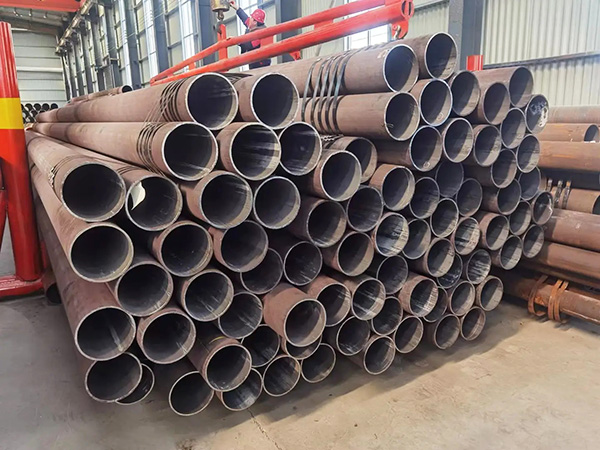
API 5L Seamless Steel Pipe
API 5L is the globally recognized specification established by the American Petroleum Institute(API)for seamless and welded steel line pipes,with seamless variants being the preferred choice for high-pressure,high-temperature,and critical f...
API 5L is the globally recognized specification established by the American Petroleum Institute(API)for seamless and welded steel line pipes,with seamless variants being the preferred choice for high-pressure,high-temperature,and critical fluid transmission scenarios.Manufactured via piercing,hot rolling,or cold drawing/extrusion processes without any longitudinal or spiral welds,API 5L seamless steel pipes deliver unmatched structural integrity,pressure resistance,and fatigue performance compared to welded alternatives,making them the backbone of oil,gas,and petrochemical pipeline networks worldwide.The standard defines two Product Specification Levels(PSL):PSL1(standard quality for general applications)and PSL2(premium quality with stricter chemical,mechanical,and non-destructive testing(NDT)requirements,ideal for low-temperature,sour service,or offshore operations).
Material Grades&Key Technical Requirements
Common Grades:Grade A,Grade B,X42,X52,X60,X65,X70,X80.The X-series grades are designated by their minimum yield strength in ksi(e.g.,X52=52 ksi≈359 MPa).PSL1 covers basic grades(A,B,X42–X70),while PSL2 includes higher grades(X42–X80)with mandatory Charpy V-notch impact tests,drop-weight tear tests(DWTT),and tighter impurity control(lower S,P content).
Mechanical Properties(Typical for Grade B):Minimum yield strength 245 MPa,minimum tensile strength 415 MPa,elongation≥21%.PSL2 grades require verified impact toughness at low temperatures(e.g.,-20°C)to prevent brittle fracture.
Chemical Composition:Controlled carbon,manganese,sulfur,phosphorus,with alloying elements(Nb,V,Ti)for grain refinement in high-strength grades.Sour service(H₂S-containing)pipes comply with Annex H of API 5L,with strict limits on hardness and sulfide stress cracking(SSC)resistance.
Manufacturing&Inspection:Produced from killed steel(PSL2 mandatory).Full hydrostatic pressure testing,90%ultrasonic testing(UT)for wall thickness and internal/external defects,eddy current testing for surface flaws.PSL2 also requires traceability and documentation throughout the production process.
Dimensions&End Configurations
Outer Diameter(OD):Typically from 168 mm up to 660 mm(custom sizes available),wall thickness(WT)ranges from 4.5 mm to 40+mm.
Length:Standard random lengths 6–12 m,fixed-length and double-length pipes available for project-specific needs.
End Types:Plain end(PE)for butt welding(most common for long-distance pipelines),threaded end(TE)with couplings,or beveled ends for field welding.
Applications
Oil&Gas Industry:Long-distance cross-country pipelines,offshore platform flowlines,subsea pipelines,refinery and petrochemical plant process piping,gathering and distribution systems.
Other Sectors:High-pressure water transmission,CO₂capture and storage(CCS)pipelines,geothermal fluid transport,power plant steam and cooling water lines.
Core Advantages
No Weld Weakness:Eliminates the risk of weld defects(porosity,cracking),ensuring uniform pressure resistance and structural reliability.
Superior Pressure&Fatigue Resistance:Ideal for high-pressure,cyclic load environments such as deepwater and arctic pipelines.
Excellent Weldability&Formability:Proper chemical composition control allows for easy field welding without compromising performance.
Global Compliance:Conforms to ISO 3183,EN 10208,and GB/T 9711,ensuring interchangeability in international projects.