

Flanged joints are among the most widely used detachable connections in industrial piping, allowing a line to be assembled, inspected, and modified without cutting the entire run. For buyers and engineers, few decisions affect long-term reliability as much as the choice between a weld neck flange and a slip-on flange. Both are covered by the same international dimension standards, yet they behave very differently under load, pressure cycling, and thermal stress. This guide explains how each type works, where each is appropriate, and how to specify the correct flange for stainless steel and other process piping.
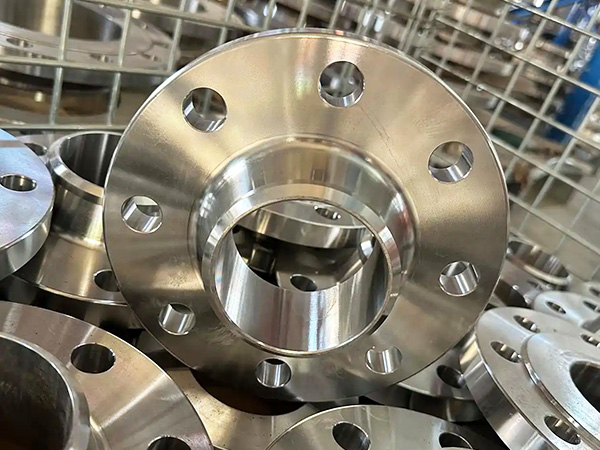
Stainless steel flanges for pipeline connection.
What Is a Weld Neck Flange?
A weld neck flange is a ring-shaped fitting with a long, tapered hub that transitions from the flange face down to the pipe outside diameter. The hub is butt-welded to the pipe, creating a continuous bore and a smooth internal flow path. Because the taper distributes mechanical stress gradually from the thicker flange section into the thinner pipe wall, a weld neck flange is the preferred design for severe service. It is commonly specified for high-pressure, high-temperature, and cyclic-loading applications such as steam lines, hydrocarbon processing, and critical process piping. The weld is a full-penetration butt weld that can be radiographically examined, which is why this type is routinely selected where code inspection is required.
What Is a Slip-On Flange?
A slip-on flange, also called a lap-on or socket-style slip flange in some markets, has a bore slightly larger than the pipe outside diameter. The pipe is inserted into the flange and secured with fillet welds at both the hub side and the bore side. The design is simpler to align and faster to install than a weld neck flange because the fit-up tolerance is more forgiving. Slip-on flanges are widely used for low-pressure water, air, and general process lines where extreme mechanical loading is not expected. Their lower machining content and easier installation generally make them the more economical option, but the fillet welds carry load differently and the internal bore has a small step at the pipe end.
Key Structural Differences
The essential difference lies in how the flange attaches to the pipe and how force travels through the joint. A weld neck flange transfers load through a tapered hub and a butt weld aligned with the pipe wall; a slip-on flange transfers load through two fillet welds and a sleeve-like overlap. This leads to several practical consequences.
- Bore geometry: weld neck provides a smooth, continuous bore; slip-on creates a slight internal step.
- Weld type: weld neck uses a butt weld that is easy to inspect; slip-on uses fillet welds that are harder to examine volumetrically.
- Stress concentration: the tapered hub reduces peak stress; the overlap of a slip-on flange concentrates stress at the weld toes.
- Fatigue behavior: weld neck performs better under vibration, thermal cycling, and repeated pressure fluctuations.
- Installation fit-up: slip-on is more tolerant of alignment error and generally faster to assemble.
Strength and Stress Distribution
Under internal pressure, a piping system experiences hoop stress and axial load at every joint. The weld neck hub acts as a structural transition, spreading bending and axial forces over a longer length of pipe, which reduces stress intensity at the weld and improves resistance to fatigue cracking. A slip-on flange places the load path closer to the flange face and relies on weld throat area rather than a continuous wall transition. For steady, low-pressure duty this is entirely adequate, but where pressure cycles, thermal expansion, or vibration are present, the difference in fatigue life becomes significant.
Pressure and Temperature Considerations
Both flange types are dimensioned under the same standards, but their pressure-temperature ratings are achieved through different wall and hub designs. Weld neck flanges are routinely chosen for higher pressure classes and elevated temperatures, including steam distribution and refinery units. Slip-on flanges are more common in lower classes and moderate temperatures, particularly in water treatment, HVAC, and utility lines. When temperature cycling is frequent, the weld neck design offers a wider safety margin. Always confirm the rating at the actual operating temperature rather than relying on the room-temperature class designation.
Sealing Performance and Gasket Interface
The sealing performance of a flanged joint depends on flange face type, gasket selection, bolt load, and surface finish — not on the neck design alone. Both types are available with raised face, flat face, and ring-type joint faces. For stainless steel piping, spiral wound gaskets are common in process service, while rubber or compressed fiber gaskets suit water and low-pressure systems. A raised face concentrates gasket seating stress but requires careful handling. Regardless of type, flange faces must be parallel and clean, bolts tightened in a cross pattern, and the gasket compatible with the medium.
Material and Corrosion Considerations
Flange material should match or exceed the corrosion resistance of the connected pipe. In stainless systems, austenitic grades 304 and 316 are widely specified; 316 offers improved chloride resistance through its molybdenum content, and duplex stainless may suit aggressive or high-strength duty. Iron contamination from carbon steel tools can initiate localized corrosion, so keep stainless components segregated, use dedicated tools, and clean the weld zone before passivation. Solution annealing and pickling restore the protective chromium oxide film.
Standards and Dimensions
Flange dimensions, drilling patterns, facing, and tolerances are governed by recognized international standards. Specifying the correct standard is essential because flange faces from different systems are not interchangeable.
- ASME B16.5 covers pipe flanges and flanged fittings in nominal sizes from NPS 1/2 through NPS 24.
- ASME B16.47 covers large-diameter steel flanges in NPS 26 and above.
- ASTM A182 specifies forged or rolled alloy and stainless steel pipe flanges and fittings.
- ASTM A105 covers carbon steel forgings for ambient and higher-temperature service.
- EN 1092-1 and DIN flanges are common in European and Asian projects.
- JIS B2220 defines Japanese industrial standard steel pipe flanges.
- ASME B16.25 specifies the buttwelding ends used on weld neck flanges.
Bolt circle diameter, number of bolt holes, bolt size, flange thickness, and facing dimensions must all match the mating flange. Mixing standards on one joint is a frequent cause of leakage and delayed installation.
Application Comparison
Weld neck flanges are specified for high-pressure steam, oil and gas transmission, chemical process lines, high-temperature systems, and services subject to vibration. Slip-on flanges are favored for low-pressure water distribution, fire protection, HVAC, compressed air, and general utilities where cost and installation speed matter more than extreme mechanical performance. Selecting the correct type means matching the joint to the operating envelope, not merely the nominal pipe size.
Cost and Procurement Considerations
Weld neck flanges require more raw material, machining, and careful welding, so their unit cost is higher. Slip-on flanges are less expensive and quicker to install, reducing fabrication time on large projects. However, the lowest purchase price is not always the lowest total cost: in severe service, a weld neck flange can reduce inspection burden, maintenance, and unplanned shutdown risk. When requesting a quotation, specify the flange type, standard, size, pressure class, material grade, face type, bore schedule, and testing requirements. Ask for a material certificate with heat-number traceability, and avoid substituting a slip-on for a weld neck flange without engineering approval.
Common Specification Mistakes
- Mixing ASME and EN or DIN flanges on the same joint, resulting in mismatched bolt circles.
- Choosing a pressure class at room temperature without checking the rating at operating temperature.
- Using a slip-on flange in a line with severe vibration or thermal cycling.
- Omitting the flange face type, leading to an incompatible gasket interface.
- Failing to match flange material to the connected pipe, creating a corrosion weak point.
Installation and Inspection Notes
For weld neck flanges, verify bevel preparation and root gap before welding, and align the internal bore smoothly with the pipe. For slip-on flanges, insert the pipe to the correct depth and apply continuous fillet welds on both sides. In both cases, use a compatible filler metal, control heat input, and clean the heat-affected zone. Critical lines may require dye penetrant or radiographic inspection. After assembly, tighten bolts in a star pattern for uniform gasket compression, then check for leakage during pressure testing.
Frequently Asked Questions
Which is stronger, a weld neck or a slip-on flange?
A weld neck flange is stronger under bending, axial load, and fatigue because its tapered hub and full-penetration butt weld form a continuous structural transition into the pipe. A slip-on flange relies on fillet welds and suits lower-pressure, steady-duty service. The correct choice depends on the line's design pressure, temperature, and loading cycles.
Can a slip-on flange be used for high-pressure service?
It is generally not recommended for high-pressure or severe cyclic service. Slip-on flanges have lower structural efficiency and their fillet welds are more prone to fatigue. For high-pressure, high-temperature, or vibrating lines, a weld neck flange is the standard engineering choice.
Are weld neck and slip-on flanges dimensionally interchangeable?
Both types can be made to the same standard, pressure class, and nominal size, so facing and bolting dimensions may match. However, they are not interchangeable in performance terms: substituting one for the other changes the load path and fatigue behavior and needs engineering review.
What information is needed to order the correct flange?
Specify the flange type, applicable standard, nominal size, pressure class, material grade, face type, pipe schedule or bore, and any inspection or certification requirements. For stainless steel flanges, confirm the grade and request a material certificate with heat-number traceability.
Why do stainless steel flanges need special handling?
Stainless steel relies on a thin chromium oxide film for corrosion resistance. Carbon steel contamination, excessive heat, or poor cleaning can damage it. Keep stainless flanges separate from carbon steel, use dedicated tools, and clean and passivate the weld area after installation.
Conclusion
The choice between a weld neck flange and a slip-on flange is a decision about load path and service severity, not simply about price. Weld neck flanges provide superior strength, fatigue resistance, and inspectable butt welds for high-pressure and demanding applications. Slip-on flanges offer economical, straightforward installation for low-pressure and general utility lines. By confirming the governing standard, pressure-temperature rating, material grade, face type, and certification, buyers can specify a flanged joint that performs reliably for the life of the pipeline.
References
[1] ASME B16.5: Pipe Flanges and Flanged Fittings, NPS 1/2 through NPS 24 Metric/Inch Standard.
[2] ASME B16.47: Large Diameter Steel Flanges, NPS 26 through NPS 60.
[3] ASME B16.25: Buttwelding Ends.
[4] ASTM A182/A182M: Standard Specification for Forged or Rolled Alloy and Stainless Steel Pipe Flanges, Forged Fittings, and Valves and Parts for High-Temperature Service.
[5] ASTM A105/A105M: Standard Specification for Carbon Steel Forgings for Piping Applications.
[6] EN 1092-1: Flanges and Their Joints – Circular Flanges for Pipes, Valves, Fittings and Accessories, PN Designated.
[7] JIS B2220: Steel Pipe Flanges.