

A technical reference for engineers and buyers: what an eccentric reducer is, why orientation matters, where it is used, and how to specify the right one.
What Is an Eccentric Reducer?
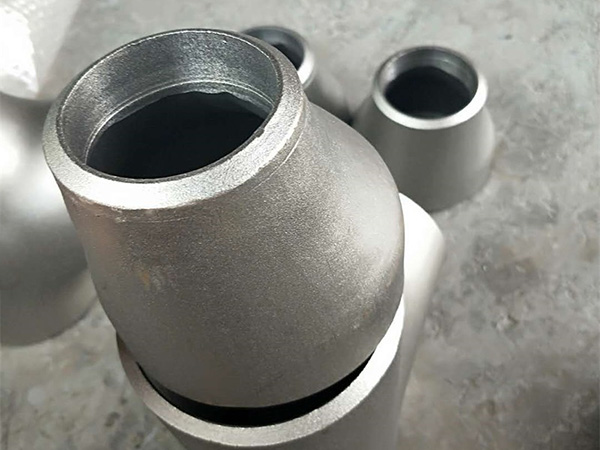
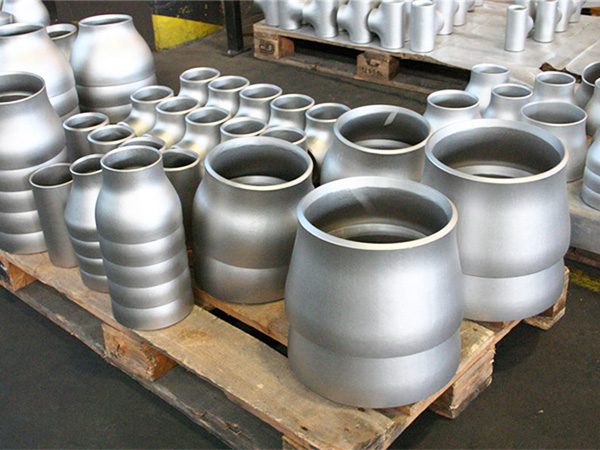
An eccentric reducer is a butt-welded pipe fitting that joins two pipes of different nominal diameters with one side flat, so the centerline of the fitting is offset rather than centered. Unlike a concentric reducer (covered in our reducer overview), the eccentric version keeps either the top or the bottom of the pipe flush across the transition. That single design choice solves two practical problems: preventing trapped air and maintaining a level pipe surface.
Design and How It Works
The flat side of an eccentric reducer means the flow path transitions between diameters without a symmetrical cone. Because one surface is straight (flat), the bore offset is constant along the fitting. In horizontal flow, this prevents a high spot where vapor or air could accumulate — a pocket that, on a pump suction line, can lead to cavitation, loss of prime, and vibration. By orienting the flat side up on suction lines, any gas rises into the larger pipe and continues downstream instead of being trapped at the reducer.
Standards and Dimensions
Eccentric reducers follow the same governing standards as concentric types:
ASME B16.9 — dimensions, length, and tolerances for the fitting.
ASTM A403 — wrought austenitic stainless steel fittings (e.g., WP304, WP316L).
ASTM A234 — carbon and alloy steel fittings.
ASTM A960 — common requirements for wrought steel fittings.
Wall thickness matches the pipe schedule (per ASME B36.19M / B36.10M). Our schedule guide shows how schedules map to wall thickness.
Materials and Manufacturing
Eccentric reducers are produced in the same material families as the connected pipe:
| Material family | Typical grade | Common driver |
|---|---|---|
| Stainless austenitic | 304/304L, 316/316L | Corrosion resistance, hygiene |
| Stainless high-temp | 321, 310S | Heat resistance |
| Duplex | 2205 | Strength + chloride resistance |
| Carbon / alloy | A234 WPB, WP11 | Cost / high-temperature strength |
Manufacturing is generally by pressing or forming from a blank, followed by solution annealing and pickling/passivation for stainless to restore corrosion resistance. Ends are beveled for butt welding per ASME B16.25.
Benefits of Eccentric Reducers
Air-pocket prevention: flat side up on suction lines keeps vapor from being trapped.
Level pipe surface: maintains top or bottom alignment for supports, insulation, and drainage.
Cavitation reduction: smoother flow entry to pumps protects equipment.
Layout flexibility: supports sloped or graded piping without introducing steps.
Typical Applications
Horizontal pump suction lines: the classic use case, flat side up.
Water and wastewater treatment: where air entrainment degrades performance.
Chemical and petrochemical lines: where vapor pockets are hazardous or reduce efficiency.
Sloped or graded pipelines: maintaining a consistent bottom or top profile.
Drains and relief lines: flat side down to keep the pipe bottom flush.
How to Select an Eccentric Reducer
Define both ends: large-end NPS and small-end NPS.
Match wall schedule: per end; they may differ.
Choose material/grade: align with the connected pipe and service.
State the standard: ASME B16.9 for dimensions; ASTM A403 (stainless) or A234 (carbon) for material.
Specify orientation: flat side up or down — this is essential and must appear on the drawing and purchase order.
Set certification: EN 10204 3.1 material certificate and any required NDT (PMI, UT, MT/PT).
Installation and Inspection
Confirm orientation before welding — an eccentric reducer installed flat-side-down on a suction line defeats its purpose. On receipt, verify:
Marking and heat number match the certificate.
End diameters and length are within ASME B16.9 tolerance.
The flat side is correctly oriented per the isometric/drawing.
Surface is sound and required NDT/certificates are present.
Eccentric vs. Concentric — Quick Decision
| Condition | Choose |
|---|---|
| Horizontal pump suction; avoid air pocket | Eccentric, flat side up |
| Level pipe bottom for drainage/support | Eccentric, flat side down |
| Centerline must stay aligned (vertical runs) | Concentric |
Why Air Pockets Cause Cavitation
A pump draws fluid by lowering pressure at its inlet. If a vapor pocket forms at an eccentric reducer installed flat-side-down on a suction line, that vapor travels into the impeller, where it collapses violently as pressure recovers. The repeated implosion — cavitation — erodes metal, raises noise and vibration, and cuts pump life. Placing the flat side up lets vapor rise into the larger pipe and vent downstream, protecting the machine.
Sizing and Dimension Notes
Size an eccentric reducer the same way as a concentric one — by large-end NPS, small-end NPS, and schedule — but add the orientation. The overall length and end diameters follow ASME B16.9. Because the fitting is offset, confirm that the resulting pipe centerline shift is acceptable in the routing and supports; in tight racks, the offset can affect neighboring lines.
Drawing the Orientation Correctly
Orientation must appear on the isometric and the purchase order, not just in the engineer's head. Use a clear note such as "ECC RED 8"×6" SCH 40S, A403 WP316L, B16.9, FLAT SIDE UP." Field crews should confirm the flat side visually before tack welding; a quick check prevents a costly cut-out.
Common Orientation Mistakes
Flat side down on horizontal pump suction — creates the very pocket you wanted to avoid.
Orientation omitted from the PO, leaving it to chance.
Assuming concentric and eccentric are interchangeable — they are not.
Overlooking the centerline offset in congested racks.
Expanded inspection checklist
Beyond the basics, confirm the flat side orientation against the drawing, check that the offset does not clash with adjacent supports, and verify the bevel condition so the weld root is sound. For stainless, ensure no carbon-steel contact occurred during transit.
Frequently Asked Questions
What is an eccentric reducer used for?
An eccentric reducer connects pipes of different diameters with one flat side, so the centerline is offset rather than centered. It is used to keep the top or bottom of the pipe flush and, most importantly, to prevent air or gas pockets in horizontal pump suction lines by placing the flat side up.
Which way should the flat side face?
On horizontal pump suction lines, the flat side is placed up so any vapor rises away from the fitting and no pocket forms that could cause cavitation. When the goal is to keep the bottom of the pipe level (e.g., for drainage or support alignment), the flat side is placed down. The orientation must follow the piping specification.
What is the difference between eccentric and concentric reducers?
A concentric reducer is symmetrical about the pipe centerline and keeps the line axially aligned. An eccentric reducer has one flat side, offsets the centerline, and is used where flush top/bottom alignment or air-pocket avoidance matters.
Which standard covers eccentric reducers?
Eccentric reducers are dimensioned by ASME B16.9 and their material is typically governed by ASTM A403 (stainless) or ASTM A234 (carbon/alloy steel), with common requirements in ASTM A960.
Can eccentric reducers be used vertically?
They can, but the offset centerline means the pipe is no longer plumb at the transition. For vertical runs where alignment matters, a concentric reducer is usually preferred; eccentric reducers are most valuable in horizontal layouts.
Conclusion
The eccentric reducer earns its place wherever a size change must not create a trapped pocket or a misaligned pipe surface. Its offset, flat-sided design — specified flat-side-up for pump suction and flat-side-down for level-bottom layouts — protects equipment and supports clean, graded piping. Select it by both end sizes, matched schedule, correct material grade, the governing standards (ASME B16.9, ASTM A403), and an explicit orientation note. Compare it directly with the concentric reducer option when finalizing your bill of materials.
Technical References
ASME. ASME B16.9 – Factory-Made Wrought Steel Buttwelding Fittings. asme.org/codes-standards
ASTM International. ASTM A403 / A403M – Wrought Austenitic Stainless Steel Piping Fittings. astm.org
ASTM International. ASTM A960 / A960M – Common Requirements for Wrought Steel Piping Fittings. astm.org
The International Stainless Steel Forum (worldstainless). Stainless steel properties and applications. worldstainless.org
Engineering Toolbox. Pipe Fittings, Reducers, and Flow Considerations. engineeringtoolbox.com