

The butt weld elbow is the foundational fitting of industrial piping systems. In virtually every process plant, transmission pipeline, and utility installation, butt weld elbows connect straight pipe runs, change direction, and manage the flow path geometry that routing constraints demand. The butt weld joint—where the fitting and pipe are beveled, aligned, and joined by a full-penetration weld—creates a joint whose integrity equals or exceeds the pipe itself. This makes the butt weld elbow the preferred fitting for any application where leak integrity, pressure containment, and joint longevity matter. Understanding the types, dimensions, materials, and specifications of butt weld elbows is a prerequisite for correct fitting selection in any industrial piping application.
Butt Weld Elbow Types: Beyond the Simple Angle
While the angle—90 degrees, 45 degrees, or less common angles—defines the basic fitting type, butt weld elbows are also classified by their geometry and the number of pipe ends they connect:
90 Degree Elbows
The butt weld elbow in 90 degree form is the most common fitting in any piping system. Every directional change that exceeds 45 degrees and requires a single fitting rather than compound shorter-radius components uses a 90 degree elbow. The 90 degree LR (long radius) elbow, with its 1.5D centerline radius, is the default specification for process piping applications where flow dynamics and joint stress considerations favor the more gradual turn. The 90 degree SR (short radius) elbow, with 1D radius, serves space-constrained applications where the routing genuinely cannot accommodate the LR geometry.
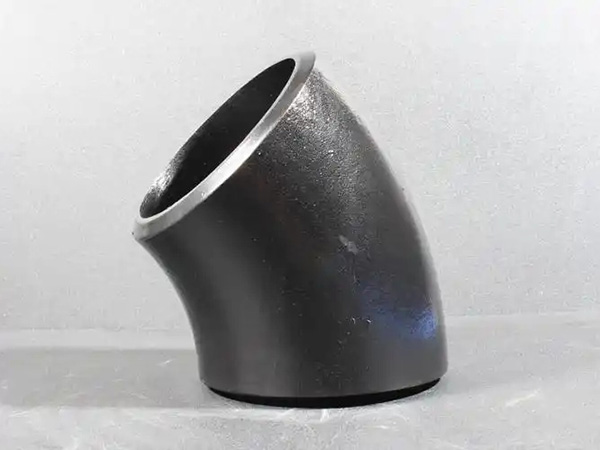
45 Degree Elbows
For shallower directional changes or for compound configurations requiring intermediate straight lengths, the 45 degree butt weld elbow provides the fitting that routing design requires. Two 45 degree elbows in series create a 90 degree change with a straight pipe section between them—useful when a flange, valve, or instrument must occupy the straight section. The 45 degree elbow also appears in drainage and slope management applications where gradual elevation changes are preferable to sharp vertical transitions.
Reducing Elbows
A reducing elbow combines a directional change with a size transition, having one end sized for a larger pipe and the other for a smaller pipe. Reducing elbows eliminate the need for a separate elbow and reducer in space-constrained locations where both a direction change and a size change occur at the same point. They are less commonly stocked than equal-size elbows but are available per ASME B16.9 for standard size combinations.
Dimensional Standards: ASME B16.9 and the Dimension Tables
ASME B16.9 establishes the dimensional standards for factory-made wrought butt welding fittings, including elbows. The standard defines the outside diameter at the bevel ends (which must match the pipe OD), the center-to-end dimensions for each radius and angle combination, and the wall thickness requirements. Compliance with B16.9 dimensions ensures that fittings from different manufacturers are interchangeable and that pipe fit-up to the bevel ends is consistent.
The key dimensional parameters for a butt weld elbow are:
Outside diameter at bevel: Matches the pipe OD for the given NPS (e.g., NPS 6 elbow has 168.3 mm OD at both ends). This OD consistency is what enables the fitting to weld to standard pipe with standard bevels.
Center-to-end dimension: The distance from the center of the fitting to the end of each outlet, which determines the overall length of the fitting and how much space it occupies in the piping system. For an LR 90 degree elbow, center-to-end equals 1.5D; for an SR 90 degree elbow, center-to-end equals 1.0D.
Wall thickness: The nominal wall thickness of the fitting, which must meet or exceed the pressure requirements of the piping system. B16.9 fittings are designed to have wall thickness at the bevel end equal to or greater than the nominal pipe wall of the corresponding schedule, but actual wall may exceed nominal to accommodate the forming process.
For the most common size and schedule combinations, these dimensions are standardized and widely available from multiple manufacturers. For non-standard sizes, heavy walls, or special alloys, lead times extend and pricing increases significantly.
Long Radius versus Short Radius: Engineering Trade-offs
The choice between LR and SR butt weld elbows involves trade-offs that engineering analysis should resolve:
Long radius elbows (centerline radius = 1.5 × NPS) provide superior flow dynamics. The gradual curvature minimizes turbulence, reduces pressure drop, and avoids the flow separation that occurs at high local velocities in SR elbows. For process piping where pressure drop affects operating cost, or where flow metering accuracy is required downstream of the elbow, LR is the appropriate choice. The larger radius also distributes the localized stress that elbow creates in the piping system, reducing fatigue accumulation in cyclic service.
Short radius elbows (centerline radius = 1.0 × NPS) occupy less space and cost less for the same size and material. The trade-off is higher pressure drop—SR elbows can create 50 to 75 percent more pressure loss than LR elbows of the same size—and higher localized piping stress. SR elbows should be specified only where space constraints genuinely prevent LR installation, and the piping stress analyst should account for the SR geometry when calculating stresses at the fitting.
A common mistake is defaulting to SR elbows throughout a piping system to save cost and space. The cumulative pressure loss and stress impact of a system full of SR fittings can outweigh the procurement savings, particularly in high-velocity or cyclic-service applications. LR elbows should be the standard; SR elbows should be the exception that engineering analysis justifies.
Material Grades and Their Applications
Butt weld elbows are produced in the same material grades as the pipe they connect, ensuring metallurgical compatibility in the welded joint and consistent pressure-temperature ratings across the piping system:
Carbon Steel Butt Weld Elbows
ASTM A234 Grade WPB is the standard material for carbon steel butt weld elbows serving process and transmission piping. WPB elbows are compatible with ASTM A106 and A53 carbon steel pipe, providing matching mechanical properties and weldability. WPC (Grade WPC) serves low-temperature applications below approximately minus 20°F (-30°C) where impact toughness requirements extend below WPB's practical range.
Stainless Steel Butt Weld Elbows
ASTM A403 covers austenitic stainless steel butt weld fittings, with WP304 and WP316 as the common grades. WP316, with its 2-3% molybdenum addition, provides the chloride pitting resistance that WP304 lacks—critical for marine, coastal, pharmaceutical, food processing, and chemical applications involving chlorides. For welded construction, the WP316L low-carbon variant minimizes sensitization in the heat-affected zone. The elbow grade should match the connected pipe grade.
Alloy Butt Weld Elbows
For elevated-temperature service with ASTM A335 alloy pipe grades (P11, P22, P91, P92), ASTM A234 alloy fittings provide matching high-temperature strength and oxidation resistance. The specific alloy grade should match the pipe specification—for A335 P22 pipe, specify A234 WP22 elbows to ensure consistent chromium-molybdenum content and matching mechanical properties at elevated temperature.
Duplex Stainless Butt Weld Elbows
ASTM A815 covers duplex stainless fittings, including UNS S32205 (2205) and S32750 (2507) grades. Duplex elbows provide the combination of chloride stress corrosion cracking resistance and high yield strength that offshore, desalination, and aggressive chemical applications demand. Welding duplex fittings requires careful procedure control to maintain the austenite-ferrite phase balance; verify that the fitting manufacturer has qualified welding procedures for duplex materials.
Industrial Applications by Sector
Oil and Gas Processing and Transmission
Butt weld elbows serve oil and gas facilities across the full production chain: upstream processing, midstream transmission, and downstream refining. In processing facilities, LR 90 degree carbon steel or alloy elbows connect vessels, towers, exchangers, and pumps in the complex piping networks that handle crude oil, natural gas, and refined products. In transmission pipelines, elbows appear at directional changes required by terrain, at station piping connections, and at valve installations. The weld integrity of butt weld joints is critical in hydrocarbon service where leaks create fire, explosion, and environmental risks.
Chemical and Petrochemical Processing
Chemical plant piping demands fittings whose material is compatible with the specific process chemistry—stainless steel for oxidizing media, alloy for high-temperature cracking service, duplex for chloride-bearing streams. Butt weld elbows in stainless and duplex materials provide the corrosion resistance and joint integrity that aggressive chemical service requires. The full-penetration butt weld eliminates the leak paths that threaded or socket weld connections introduce in aggressive environments.
Power Generation
Power plant piping systems use butt weld elbows across all temperature and pressure ranges: low-pressure feedwater and condensate return (carbon steel), high-pressure main steam (alloy steel P91/P92), cooling water (carbon steel with coating or lined), and auxiliary systems throughout the facility. The heavy-wall butt weld elbows required for high-pressure steam service are produced to match the thick-wall pipe specifications that ASME B31.1 and B31.3 establish.
Water and Wastewater Treatment
Municipal water treatment and distribution uses carbon steel butt weld elbows with cement mortar lining or fusion-bonded epoxy coating for internal corrosion protection. The coated elbows connect the pipes that carry treated water, chemical streams, and sludge through the treatment process. Offshore and marine water intake structures use coated and lined carbon steel elbows to resist the combined effects of seawater and marine atmospheric corrosion.
Specification and Procurement: Getting the Fitting You Need
Complete specification of a butt weld elbow requires the following information to reach the supplier:
Type: 90 degree, 45 degree, reducing, or special angle
Radius: Long Radius (LR) or Short Radius (SR)
Size: NPS size (e.g., NPS 6)
Schedule: Wall thickness designation (e.g., Schedule 40, Schedule 80)
Material grade: ASTM specification and grade (e.g., ASTM A234 WPB)
Quantity: Number of fittings required
Testing or certification: Material test reports, API 5L PSL 2, EN 10204 Type 3.1, or project-specific requirements
Coating or lining: If required for the application (FBE, cement mortar, etc.)
The most common procurement error is specifying only the angle and size—"NPS 6 90 degree elbow"—without specifying radius, material, or schedule. The supplier then interprets the order according to what is standard in their production, which may or may not match the application requirement. Complete specification eliminates this ambiguity and ensures the fitting arrives ready to install.
Conclusion
The butt weld elbow is the workhorse fitting of industrial piping systems, providing directional changes with full-penetration welded joints whose integrity matches or exceeds the connected pipe. Selecting the correct type—90 or 45 degree, LR or SR—follows from routing analysis, pressure drop considerations, and available space. Specifying the correct material and schedule ensures metallurgical compatibility and adequate pressure capability. Complete procurement specification, including radius, material, and schedule, prevents the delivery of fittings that do not match the application requirement.
For engineers, the selection process should document the basis: routing constraints justify SR or LR, material follows from process chemistry and temperature, and schedule follows from pressure calculation. For procurement professionals, the specification should be complete and unambiguous, giving the supplier everything needed to deliver the correct fitting the first time. When the specification is right, the fitting fits, the weld goes in cleanly, and the system performs as designed.
FAQ
Q: What is the dimensional standard for butt weld elbows?
A: ASME B16.9 establishes the dimensional standards for factory-made wrought butt welding fittings including elbows. It defines outside diameter at the bevel ends (matching pipe OD), center-to-end dimensions for each radius and angle, and wall thickness requirements. B16.9 dimensions ensure interchangeability between manufacturers and consistent fit-up with standard pipe.
Q: When should I specify long radius versus short radius butt weld elbows?
A: Specify Long Radius (LR, 1.5D centerline radius) as the standard for most process applications due to lower pressure drop and reduced piping stress. Specify Short Radius (SR, 1.0D) only where space constraints genuinely prevent LR installation and engineering analysis confirms that the higher pressure drop and stress of SR are acceptable for the specific application.
Q: What material should I specify for stainless steel pipe butt weld elbows?
A: Match the elbow material to the pipe material. For ASTM A312 TP304 pipe, specify ASTM A403 WP304 elbows. For TP316 pipe, specify A403 WP316 elbows. For welded construction, the low-carbon WP316L variant minimizes sensitization in the heat-affected zone. Do not mismatch elbow and pipe materials, as this creates weld incompatibility and potential galvanic corrosion at the joint.
Q: Can butt weld elbows be used in all pressure classes?
A: Butt weld elbows are suitable for all pressure classes from low-pressure utility piping through high-pressure transmission and process piping. The pressure-temperature rating of the elbow depends on the material grade, wall thickness, and temperature. For very high pressures, the fitting wall may need to exceed standard B16.9 nominal wall to meet the pressure design requirements—confirm with the manufacturer for extreme pressure applications.
Q: What information is required when ordering butt weld elbows?
A: Provide: angle (90, 45, or other), radius (LR or SR), NPS size, schedule, material grade per ASTM specification, quantity, and any special requirements (coating, lining, testing, certification). Specifying completely prevents the supplier from substituting a standard fitting that may not match the application requirement.
References
ASME. (2023). ASME B16.9: Factory-Made Wrought Buttwelding Fittings. New York, NY.
ASTM International. (2024). ASTM A234/A234M-24: Standard Specification for Piping Fittings of Wrought Carbon Steel and Alloy Steel. West Conshohocken, PA.
ASTM International. (2024). ASTM A403/A403M-24: Standard Specification for Wrought Austenitic Stainless Steel Piping Fittings. West Conshohocken, PA.
ASTM International. (2024). ASTM A815/A815M-24: Standard Specification for Wrought Ferritic, Ferritic/Austenitic, and Martensitic Stainless Steel Piping Fittings. West Conshohocken, PA.
American Society of Mechanical Engineers. (2023). ASME B31.3: Process Piping. New York, NY.