

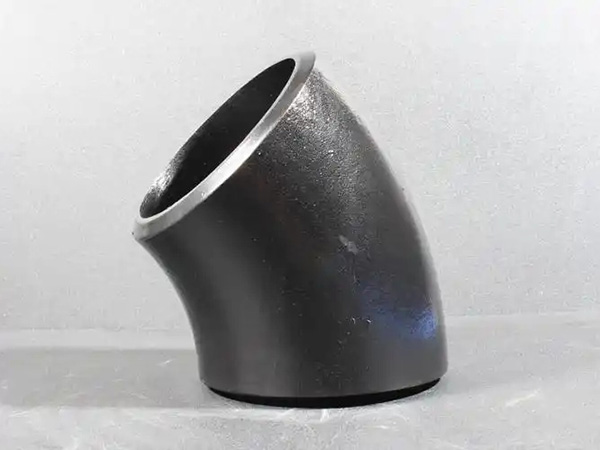
In the hierarchy of pipe fittings, the 45 degree pipe elbow occupies a specialized niche. It is less common than its 90 degree counterpart, and engineers who reach for it without understanding its specific characteristics often create routing complications that a properly selected alternative would have avoided. Yet when the conditions are right—when the routing requires a shallow directional change, when pressure loss minimization matters, or when space constraints preclude larger-radius bends—the 45 degree elbow is the precisely correct solution. This guide examines when and how to use 45 degree elbows in industrial piping systems, how to select the right radius and material, and what the specification should communicate to ensure the fitting that arrives on site actually fits the application.
How 45 Degree Elbows Differ from 90 Degree Elbows
The angular deflection is the obvious difference—a 45 degree elbow changes flow direction by 45 degrees, versus 90 degrees for the more common fitting. But the engineering implications extend beyond the angle. A 90 degree elbow requires a single fitting; two 45 degree elbows in a pull/push configuration create a compound 90 degree change with a straight pipe section between them. This straight provides clearance for flanged connections, valves, or instruments that would not fit between the end of a 90 degree elbow and the adjacent obstruction.
From a flow dynamics perspective, the 45 degree elbow creates less turbulence and pressure loss than a 90 degree elbow in equivalent radius and size. The shallower turning angle means the fluid experiences a gentler directional transition, reducing secondary flow patterns and boundary layer separation that contribute to pressure drop. For large-diameter, high-velocity, or cost-sensitive flow systems where pressure loss translates directly to operating cost, the 45 degree elbow's superior hydraulic performance may justify its use in compound configurations rather than a single 90 degree fitting.
Long Radius versus Short Radius: What the Radius Means
The centerline radius of an elbow—the distance from the elbow's center point to the centerline of the connected pipe—determines how sharply the flow path curves. ASME B16.9 defines two standard radii for butt weld elbows:
Long Radius (LR) elbow: Centerline radius equals 1.5 times the nominal pipe size. An NPS 6 LR 45 degree elbow has a centerline radius of 9 inches (6 × 1.5). LR elbows are the default specification for most process piping applications because the gradual curvature minimizes pressure drop and avoids the flow disturbances that sharper bends create.
Short Radius (SR) elbow: Centerline radius equals 1.0 times the nominal pipe size. An NPS 6 SR 45 degree elbow has a centerline radius of 6 inches. SR elbows occupy less space and cost less for the same size and material, but create higher pressure drop and impose greater localized stresses on the piping system. They are specified where space is genuinely constrained and the pressure loss penalty is acceptable.
For a 45 degree pipe elbow, the practical difference between LR and SR is less pronounced than for 90 degree elbows because the shorter total turning angle produces less flow disturbance regardless of radius. However, the LR remains the default choice for process applications where pressure drop and flow uniformity matter, while SR finds application in compressed space situations—inside equipment bundles, within building utility shafts, or where multiple fittings must be stacked within a limited footprint.
Applications Where 45 Degree Elbows Excel
Gradual Directional Changes in Long Piping Runs
When routing pipelines across terrain with gentle elevation changes, a series of 45 degree elbows provides a gradual slope adjustment that avoids the sharp vertical transitions a 90 degree elbow would create. A pipeline descending 2 meters over a 10-meter horizontal run uses two or three 45 degree elbows to achieve the slope, maintaining clearance above and below for supports, walkways, or other pipeline crossings. Using 90 degree elbows would create excessive depth at the transition point and complicate drainage and maintenance access.
Compound Direction Changes with Intermediate Clearance
The two-45s-in-series configuration—where two 45 degree elbows create a 90 degree change with a straight pipe section between them—serves applications where a valve, flange, or instrument must be positioned in the straight section. A single 90 degree elbow would not provide the clearance between the fitting and the flange face needed for bolt-up access. Using two 45 degree elbows creates the required straight length while still achieving the directional change the routing demands.
The minimum straight length between the two elbows should be sufficient for flange access and for any field welding that may be required at the joint. ASME B31.3 provides guidance on minimum straight lengths upstream and downstream of fittings for flow meter installation, but for general routing, a length equal to the pipe diameter (or the bolt length plus clearance, whichever is greater) is typically adequate.
Intake and Exhaust Ductwork
Large-diameter air intake and exhaust systems—common in power plants, HVAC installations, and industrial ventilation—often use 45 degree elbows in preference to 90 degree elbows because of their superior aerodynamic performance. At large diameters where pressure drop in fittings can equal several meters of equivalent pipe length, using LR 45 degree elbows in compound configurations reduces fan power requirements and improves system efficiency over the service life.
Subsea Pipeline J-Lay and S-Lay Configurations
Offshore pipeline installation using J-lay or S-lay methods uses 45 degree and other non-standard angle pipe bends to manage the transition between horizontal seabed routing and the inclined launch ramp of the lay vessel. These specialized applications require factory-formed bends and pup pieces rather than standard catalog fittings, but the underlying principle—using the correct angle to manage directional change in space-constrained or performance-sensitive routing—remains the same.
Butt Weld versus Socket Weld and Threaded Connections
The connection method for a 45 degree pipe elbow follows from the application, the pressure-temperature rating, and the fabrication approach:
Butt weld elbows per ASME B16.9 connect by butt welding the pipe end to the fitting bevel, creating a full-penetration joint with strength equal to or exceeding the pipe. Butt weld is the standard for process piping applications where the joint is designed as part of the pressure boundary and where leak integrity is critical. The elbow and pipe must have matching OD and wall thickness for proper fit-up.
Socket weld fittings per ASME B16.11 connect by inserting the pipe into a socket and fillet-welding the outside. Socket weld is used for small-diameter high-pressure applications (typically NPS 1/2 through NPS 2) where butt weld fabrication would be impractical. The socket weld joint is limited by the socket bore and is not recommended for cyclic thermal service where differential thermal expansion can crack the fillet weld.
Threaded elbows per ASME B16.11 use female NPT threads to connect to threaded pipe ends. Threaded connections are limited to lower-pressure applications (typically Class 2000 or 3000 ratings) and are increasingly avoided in new process piping construction due to leak potential and the difficulty of maintaining threaded joints in aggressive service.
Material Selection for 45 Degree Elbows
The elbow material must match the connected pipe material for welding compatibility and pressure boundary integrity. Common material options include:
Carbon steel (ASTM A234 WPB/WPC): The standard for ASTM A106 and A53 carbon steel pipe. WPB is the most common grade, serving water, steam, and hydrocarbon service at moderate temperatures.
Stainless steel (ASTM A403 WP304/WP316): For ASTM A312 stainless pipe systems. WP316 provides the molybdenum addition for chloride and reducing acid service. The elbow grade should match the pipe grade (TP304 to WP304, TP316 to WP316).
Alloy (ASTM A234 WP11, WP22, WP91): For elevated-temperature service with ASTM A335 alloy pipe. The alloy elbow material must match the pipe alloy grade for welding and for mechanical property consistency across the joint.
Mismatching elbow and pipe materials creates weld incompatibility risk and creates a galvanic or corrosion couple at the joint. Specify the elbow material to match the connected pipe material explicitly, rather than relying on the supplier to interpret a generic specification correctly.
Specification Checklist for 45 Degree Elbows
Complete procurement specification for a 45 degree pipe elbow should include:
Angle: 45 degrees
Radius: LR (1.5D) or SR (1D)
NPS size and schedule
Connection type: butt weld, socket weld, or threaded
Material grade matching connected pipe specification
ASTM specification: A234, A403, or as project requires
Pressure-temperature rating confirmation
End preparation: bevelled for butt weld, threaded for threaded
Testing or certification requirements: API 5L, ASTM material test report
Quantity
Incomplete specifications—omitting radius, material, or schedule—create ambiguity that the supplier resolves by delivering whatever standard fitting they have available, which may not match the application requirement.
Common Mistakes in 45 Degree Elbow Selection
The most frequent specification and selection errors with 45 degree pipe elbows include:
Assuming SR is always acceptable: SR elbows save space and cost but impose higher pressure drop and greater localized piping stress. Specifying SR without confirming that pressure loss is acceptable and that piping stress analysis has accounted for the tighter curvature leads to operational problems that the procurement savings do not justify.
Specifying 45 degree without specifying radius: LR and SR 45 degree elbows are not interchangeable. The centerline radius affects fit-up, clearance requirements, and pressure drop. Specify both angle and radius explicitly.
Mismatching elbow material to pipe: Welding a stainless elbow to carbon steel pipe, or using the wrong alloy grade, creates weld quality problems, potential corrosion issues, and specification non-compliance. Match materials explicitly.
Using threaded elbows in high-pressure or cyclic service: Threaded connections leak. Using threaded 45 degree elbows in high-pressure hydrocarbon or steam service creates the conditions for dangerous leaks in aggressive environments. Use butt weld for process-critical joints.
Conclusion
The 45 degree pipe elbow is the correct fitting choice when routing requires a shallow directional change, when compound configurations need intermediate straight lengths, or when pressure loss minimization justifies its superior hydraulic performance over a 90 degree elbow. Selecting between long radius and short radius, specifying the correct material and connection type, and communicating complete requirements in the procurement specification ensures that the elbow on the shelf fits the application it was ordered for.
For engineers working on routing problems, the principle is straightforward: reach for the 45 degree elbow when the routing genuinely benefits from its characteristics—not as a default for everything that is not a 90 degree turn. For procurement professionals, the key is specifying completely: angle, radius, size, schedule, material, and connection type leave no ambiguity for the supplier and no surprises at installation. When the specification is complete, the fitting fits.
FAQ
Q: What is the difference between a long radius and short radius 45 degree elbow?
A: Long Radius (LR) elbows have a centerline radius of 1.5 times the NPS size; Short Radius (SR) elbows have a centerline radius equal to 1.0 times the NPS size. LR elbows create less pressure drop and impose lower localized stress on the piping system. SR elbows save space and cost but impose higher pressure drop and stress. LR is the default for most process applications; SR is specified only where space genuinely constrains the routing.
Q: When should I use two 45 degree elbows instead of a single 90 degree elbow?
A>Use two 45 degree elbows in series when a valve, flange, or instrument must fit between the elbows in the straight section. The intermediate straight length provides clearance for bolt-up access and eliminates the interference that would exist if a flange were placed directly at the end of a 90 degree elbow. Two 45s also create less total pressure drop than a single 90 degree LR elbow in many configurations.
Q: What material should a 45 degree elbow have for carbon steel pipe systems?
A: For ASTM A106 or A53 carbon steel pipe, specify ASTM A234 WPB (or WPC for low-temperature) butt weld elbows. The elbow material should match the pipe specification. WPB elbows are readily available; WPC is used for low-temperature service below minus 20°F. Always match the elbow material to the pipe material to ensure weld compatibility and consistent pressure-temperature rating.
Q: Can socket weld or threaded 45 degree elbows be used in process piping?
A: Socket weld is acceptable for small-diameter high-pressure applications (typically NPS 1/2 through NPS 2) where butt weld fabrication is impractical. Threaded connections are limited to low-pressure applications (Class 2000 or 3000) and are increasingly avoided in new process piping construction due to leak risk. For most process piping applications, butt weld is the standard connection method.
Q: How does the 45 degree elbow affect pressure drop compared to a 90 degree elbow?
A: A 45 degree elbow creates less pressure drop than a 90 degree elbow of the same radius and size. Using multiple 45 degree elbows in a compound configuration can create a total 90 degree turn with less combined pressure drop than a single 90 degree LR elbow. This hydraulic advantage matters in high-velocity or large-diameter systems where fitting pressure loss is significant relative to pipe friction loss.
References
ASME. (2023). ASME B16.9: Factory-Made Wrought Buttwelding Fittings. New York, NY.
ASME. (2022). ASME B16.11: Forged Fittings, Socket-Welding and Threaded. New York, NY.
ASTM International. (2024). ASTM A234/A234M-24: Standard Specification for Piping Fittings of Wrought Carbon Steel and Alloy Steel. West Conshohocken, PA.
ASTM International. (2024). ASTM A403/A403M-24: Standard Specification for Wrought Austenitic Stainless Steel Piping Fittings. West Conshohocken, PA.
American Society of Mechanical Engineers. (2023). ASME B31.3: Process Piping. New York, NY.