

Seamless pipe dominates discussions of high-pressure and critical-service applications, but the reality of industrial procurement is that welded pipe serves the majority of large-diameter and many medium-diameter applications across oil and gas, water distribution, structural, and construction industries. Understanding the different welded steel pipe types—how they are manufactured, what they can achieve, and where each excels—enables procurement professionals to make specification decisions that balance performance requirements against the cost advantages that welded production offers. This guide examines the three primary welded pipe types: ERW, LSAW, and SSAW.
Electric Resistance Welded (ERW) Pipe
ERW pipe is produced by forming flat steel plate or coil into a cylindrical shape and then welding the longitudinal seam using electrical resistance heating. The process begins with an uncoiler or plate feeder that supplies the skelp—the flat steel strip that will become the pipe. A series of forming rolls progressively shapes the skelp into a tube with the edges meeting along a longitudinal line. High-frequency electrical current is then applied to the seam edges through contacts or an induction coil, heating the steel to forging temperature without filler metal. Pressure rolls forge the heated edges together, creating a solid-state weld.
The weld seam in ERW pipe is distinct from the submerged arc welded seams of LSAW and SSAW. Because ERW uses no filler metal and creates a forged bond rather than a cast weld deposit, the weld zone microstructure can approach the parent material properties when properly processed. Modern high-frequency ERW process—operating at 100 to 400 kHz—produces a narrow, controllable heat-affected zone that preserves base metal properties more effectively than older low-frequency processes.
ERW pipe is commercially available in diameters from approximately NPS 2 through NPS 24, with wall thicknesses ranging from standard through extra-strong schedules. The process is most economical in medium diameters (NPS 4 through NPS 16) where production rates are high and dimensional consistency is well controlled. For diameters above NPS 24, the coil width limitations of ERW forming make LSAW or SSAW production more practical.
Longitudinal Submerged Arc Welded (LSAW) Pipe
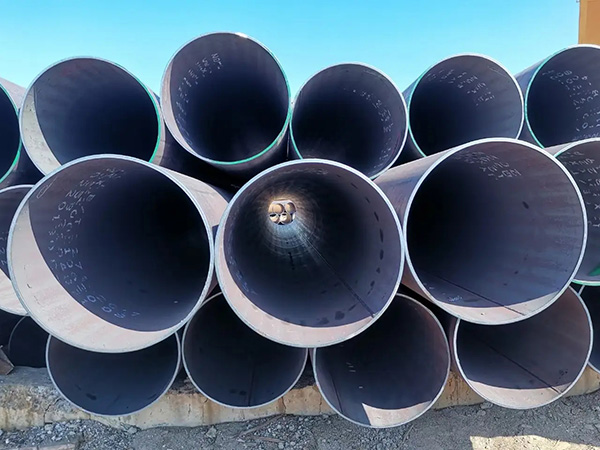
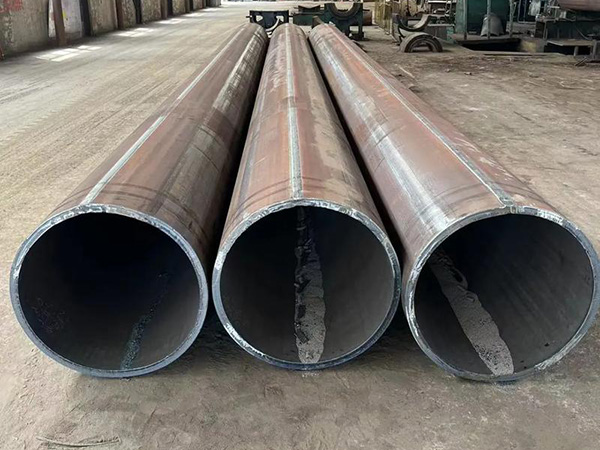
LSAW pipe is produced from individual steel plates rather than coil, formed into cylindrical shape through a JCO or UOE forming process, and welded along the longitudinal seam using submerged arc welding. The submerged arc process deposits weld metal into the seam while the weld zone is covered by a blanket of granular flux that shields the molten weld pool from atmospheric contamination and shapes the weld bead profile.
The JCO forming process progressively presses the plate into a J-shape, then a C-shape, and finally an O-shape through a series of hydraulic presses. The UOE process forms the plate into a U-shape, then an O-shape, and applies mechanical expansion to achieve final dimensional precision. Both processes produce pipe with a straight longitudinal weld seam running the full length of the pipe.
LSAW production dominates the large-diameter welded pipe market. Commercial availability extends from approximately NPS 16 through NPS 100 or larger, with wall thicknesses ranging from 6 to 50 millimeters depending on diameter. The process produces pipe with excellent dimensional precision—particularly through the UOE process with mechanical expansion—and weld quality suitable for high-pressure transmission pipeline applications.
The longitudinal seam orientation in LSAW pipe means the weld runs parallel to the principal stress direction in pressurized service. This orientation requires that the weld possess adequate mechanical properties to withstand the hoop stress that internal pressure generates. API 5L and equivalent specifications impose stringent testing requirements on the weld seam, including tensile testing, bend testing, and Charpy impact testing of the weld metal and heat-affected zone.
Spiral Submerged Arc Welded (SSAW) Pipe
SSAW pipe is produced by forming steel coil into a helical spiral and welding both the inner and outer seams using submerged arc welding. The helical forming process winds the coil at a specific angle that determines the pipe diameter—the same coil width can produce different diameters by adjusting the helix angle. This flexibility allows a single production line to manufacture a range of diameters without changing forming equipment.
The spiral weld seam runs at an angle to the pipe axis, typically 30 to 60 degrees from longitudinal. This orientation means the weld crosses the principal hoop stress direction at an angle rather than running parallel to it. The stress distribution in the weld differs from LSAW's longitudinal orientation—the spiral weld experiences combined stresses that require engineering analysis during design.
SSAW pipe is commercially available in diameters from approximately NPS 12 through NPS 120 or larger, with wall thicknesses from 5 to 25 millimeters. The process is particularly economical for large diameters where the cost of wide plates for LSAW production becomes prohibitive. SSAW can produce large-diameter pipe from narrower, less expensive coil material.
Historically, SSAW pipe carried quality concerns related to weld consistency and residual stress from the spiral forming process. Modern SSAW production lines with automated welding control, internal welding stations, and mechanical expansion have substantially closed the quality gap with LSAW for many applications. However, for the most demanding high-pressure or critical-service applications, LSAW remains the preferred choice due to its simpler stress analysis and more controlled weld geometry.
Comparing the Three Types: What Buyers Need to Know
Each welded steel pipe type occupies a distinct position in the procurement landscape. The selection depends primarily on diameter range, pressure requirements, and the economic balance between material cost and performance capability:
ERW excels in small to medium diameters (NPS 2 through NPS 16) for moderate-pressure applications including water distribution, structural, and oil and gas gathering service. Its high-frequency forge weld produces a narrow heat-affected zone with good mechanical properties when properly manufactured. ERW typically offers the lowest per-unit cost in its diameter range.
LSAW dominates large-diameter applications (NPS 16 and above) for high-pressure transmission, offshore pipelines, and structural applications requiring excellent dimensional control. The longitudinal seam provides straightforward stress analysis, and the UOE expansion process achieves tight dimensional tolerances. LSAW commands a price premium over ERW and SSAW but delivers superior quality for demanding applications.
SSAW provides economical large-diameter pipe (NPS 12 and above) for moderate-pressure water transmission, piling, structural, and some pipeline applications. Its ability to produce various diameters from standard coil widths creates cost flexibility. Modern SSAW production quality approaches LSAW for many applications, though critical high-pressure service typically specifies LSAW.
Welded Versus Seamless: When Each Makes Sense
The choice between welded and seamless steel pipe depends on application requirements that go beyond cost. Welded pipe offers wider size availability—particularly in large diameters where seamless production becomes impractical or prohibitively expensive. Welded pipe also typically offers shorter lead times due to higher production rates and broader manufacturing base.
Seamless pipe provides advantages in pressure-critical service, fatigue-cyclic applications, and environments where weld seam integrity is a concern. The absence of a longitudinal weld eliminates the heat-affected zone, the potential for weld defects, and the metallurgical discontinuity that welded constructions introduce. For high-pressure, high-temperature, or cyclic-loading service, seamless construction provides the reliability margin that these applications demand.
Many industrial projects use both—seamless for critical process piping and high-pressure service, welded for utility lines, structural applications, and large-diameter transmission where welded alternatives provide adequate performance at lower cost. This differentiated approach optimizes total project cost without compromising reliability where it matters most.
Quality Verification for Welded Pipe
Welded pipe quality verification requires attention to the weld seam specifically. Non-destructive examination typically includes ultrasonic testing of the weld seam for internal defects, radiographic examination for weld integrity verification, and hydrostatic pressure testing for leak-tightness. For API 5L welded pipe, the specification imposes specific testing requirements including weld seam tensile testing, guided bend testing, and Charpy impact testing of the weld and heat-affected zone for PSL 2.
Mill Test Reports for welded pipe should document not only the base material properties but also the weld seam test results. The weld metal and heat-affected zone properties may differ from the base material, and specification compliance requires verification of all three zones. Buyers should review weld procedure qualification records (WPS/PQR) for critical applications to confirm that welding parameters are properly established and validated.
Conclusion
Understanding welded steel pipe types enables procurement professionals to make specification decisions that balance performance requirements, size availability, and economic efficiency. ERW serves small to medium diameters with economical production for moderate-pressure applications. LSAW dominates large-diameter, high-pressure service where longitudinal weld geometry and dimensional precision matter. SSAW provides cost-effective large-diameter pipe for moderate-duty applications where its production flexibility and material economics offer advantage.
The selection between welded types—and between welded and seamless alternatives—should follow from documented engineering analysis of service conditions, not from habit or generic preference. Projects that match pipe type to actual application requirements consistently achieve better total cost outcomes than those that over-specify uniformly or default to the cheapest available option. For buyers seeking guidance on selecting the appropriate welded pipe type for a specific application, consulting with a manufacturer who produces multiple pipe types can provide the perspective needed to optimize the specification.
FAQ
Q: Is ERW pipe suitable for high-pressure oil and gas applications?
A: ERW pipe can serve moderate-pressure oil and gas applications when produced to API 5L PSL 2 requirements with proper weld testing. However, for high-pressure transmission above approximately 1,440 PSI, for cyclic loading service, or for sour gas applications where weld seam integrity is critical, seamless or LSAW pipe is typically specified. The application's design code and project specifications determine acceptability.
Q: What is the difference between LSAW and SSAW pipe?
A: LSAW pipe has a straight longitudinal weld seam running parallel to the pipe axis, produced from individual plates through JCO or UOE forming. SSAW pipe has a helical spiral weld seam running at an angle to the pipe axis, produced from coil. LSAW offers better dimensional control and simpler stress analysis; SSAW offers production flexibility and lower cost for large diameters using narrower material.
Q: Can welded pipe replace seamless pipe in all applications?
A: No. Applications involving high pressure with cyclic loading, severe temperature gradients, sour service, or where fracture control plans mandate seamless construction require seamless pipe. Welded pipe provides adequate performance for many applications—including some moderate-pressure pipeline service—but the weld seam introduces a metallurgical discontinuity that is unacceptable for the most demanding service conditions.
Q: What diameter range is each welded pipe type available in?
A: ERW is typically available from NPS 2 through NPS 24. LSAW is available from approximately NPS 16 through NPS 100 or larger. SSAW is available from approximately NPS 12 through NPS 120 or larger. The overlap zones—particularly NPS 16 through NPS 24—allow selection based on pressure requirements, cost optimization, and project specification preferences.
Q: What weld testing should I require for welded steel pipe?
A: Require ultrasonic testing of the weld seam for internal defects, radiographic examination for weld integrity, and hydrostatic pressure testing for leak-tightness. For API 5L PSL 2, additional requirements include weld seam tensile testing, guided bend testing, and Charpy impact testing of the weld metal and heat-affected zone. Mill Test Reports should document both base material and weld seam test results.
References
American Petroleum Institute. (2024). API Spec 5L, 47th Edition: Specification for Line Pipe. Washington, DC.
ASTM International. (2024). ASTM A53/A53M-24: Standard Specification for Pipe, Steel, Black and Hot-Dipped, Zinc-Coated, Welded and Seamless. West Conshohocken, PA.
American Society of Mechanical Engineers. (2022). ASME B31.8: Gas Transmission and Distribution Piping Systems. New York, NY.
American Welding Society. (2023). AWS D1.1: Structural Welding Code—Steel. Miami, FL.
Kim, Y.K. & Park, J.S. (2023). "Weld Quality Assessment in High-Frequency ERW Pipe Manufacturing." Journal of Manufacturing Processes, 89, 45-59.