

When industrial projects require large-diameter steel pipe with high-pressure capability and tight dimensional control, LSAW steel pipe is often the specification that emerges from the engineering analysis. Longitudinal Submerged Arc Welded pipe combines the economic advantages of welded production with the performance characteristics that critical pipeline and structural applications demand. Understanding how this pipe type is manufactured—and how manufacturing variables affect finished product properties—helps procurement teams and engineers specify, verify, and deploy LSAW pipe with confidence in its performance.
What Makes LSAW Different from Other Welded Pipe
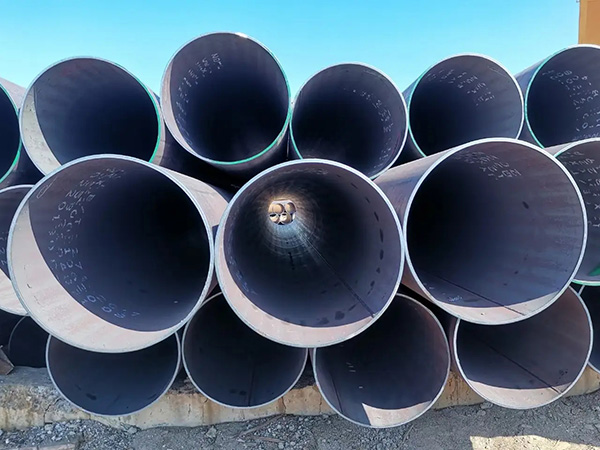
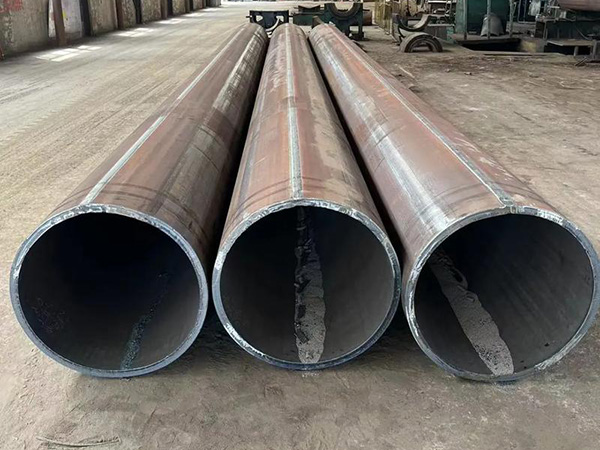
Three characteristics distinguish LSAW steel pipe from other welded pipe types. First, the longitudinal seam orientation: the weld runs straight along the pipe length, parallel to the principal hoop stress direction under internal pressure. This orientation simplifies stress analysis compared to the helical weld of SSAW pipe, where the weld crosses the stress field at an angle. Second, the submerged arc welding process: the weld deposit is formed under a blanket of granular flux that shields the molten pool from atmospheric contamination, producing a sound, ductile weld with controlled chemistry and geometry. Third, the plate-based production: LSAW is manufactured from individual rolled plates rather than coil, enabling tighter control of incoming material properties and the production of thick-wall pipe that exceeds coil-based manufacturing capability.
These three characteristics combine to produce pipe that serves the most demanding welded pipe applications—high-pressure transmission, offshore platforms, structural columns, and penstocks where failure consequences preclude the use of lower-quality alternatives.
The JCO Forming Process
JCO forming represents one of the two primary manufacturing routes for LSAW steel pipe. The designation describes the progressive shape transformation that the plate undergoes: J-shape, C-shape, O-shape. The process begins with a flat steel plate of the required width, thickness, and grade, edge-milled to achieve the precise weld bevel geometry that the welding procedure requires.
A series of hydraulic presses progressively forms the plate. The first pressing operation creates a J-shaped profile by bending one edge of the plate into a partial curve. Successive pressing operations advance along the plate length, gradually forming the second edge until the plate assumes a C-shaped profile. Final pressing closes the C into an O-shape, bringing the two prepared edges together with the correct root gap and alignment for welding.
JCO forming offers several manufacturing advantages. The progressive forming approach distributes deformation more evenly than single-stroke UOE pressing, reducing residual stress in the finished pipe. The process adapts readily to different diameters and wall thicknesses without major equipment changeover, providing production flexibility that suits mixed-order manufacturing. Tooling investment is lower than UOE, making JCO economically attractive for medium-volume production runs and specialized orders.
The trade-off is production rate: JCO forming is slower than UOE pressing, which limits its competitiveness for very high-volume orders where UOE's throughput advantage offsets its higher tooling cost. For many project-oriented orders involving multiple diameters, grades, and wall thicknesses, JCO's flexibility provides better overall economics despite the per-piece speed disadvantage.
The UOE Forming Process
UOE forming—the second primary manufacturing route—uses three distinct operations to transform flat plate into finished pipe shape. The U-press first bends the plate into a U-shape using a punch and die arrangement. The O-press then closes the U into an O-shape through full-circumference compression, achieving more uniform roundness than progressive JCO forming. Finally, mechanical expansion—typically 0.5 to 1.5 percent of the pipe diameter—calibrates the final dimensions, relieves forming residual stresses, and achieves the roundness and straightness tolerances that high-pressure pipeline specifications require.
The mechanical expansion step is where UOE production achieves its distinctive dimensional precision. By expanding the pipe against precisely machined die segments, the process produces roundness tolerances of 0.5 percent or better—significantly tighter than what forming alone achieves. This precision matters in pipeline construction where field welding requires consistent fit-up, and in offshore applications where structural connection tolerances are demanding.
UOE production lines require substantial capital investment in large-capacity presses, expansion equipment, and material handling systems. This investment creates high fixed costs that demand high utilization rates for economic operation. UOE lines typically serve large-volume orders—pipeline projects requiring thousands of tons of pipe in consistent sizes—where the throughput advantage and dimensional precision justify the capital intensity.
Submerged Arc Welding: Interior and Exterior Seams
After forming, the longitudinal seam is welded using submerged arc welding (SAW)—typically in two passes. The interior weld is deposited first, with the pipe positioned to allow the welding head access to the inside surface. The exterior weld follows, with the pipe rotated or the welding head repositioned to deposit the outer pass. Each pass is performed under a blanket of granular flux that protects the molten weld pool from oxygen and nitrogen pickup, shapes the bead profile, and slows the cooling rate to prevent hard, brittle microstructures.
The welding parameters—current, voltage, travel speed, wire diameter, flux type, and preheat temperature—are established through Welding Procedure Specifications (WPS) that are validated through Procedure Qualification Records (PQR). These documents demonstrate that the welding parameters produce weld metal and heat-affected zone properties meeting the applicable specification's mechanical and toughness requirements. For API 5L PSL 2 pipe, the qualification testing includes tensile testing of the weld seam, guided bend tests, and Charpy impact testing of the weld metal, fusion line, and heat-affected zone.
Weld quality in LSAW steel pipe depends on consistent execution of qualified procedures. Modern LSAW production lines use automated welding control systems that monitor and adjust parameters in real time, reducing the variability that manual welding introduces. Automatic seam tracking ensures the weld is deposited precisely along the seam centerline, even when minor forming variations exist. These controls produce the weld consistency that high-pressure and critical-service applications require.
Dimensional Capability and Size Range
LSAW production covers the large-diameter range that ERW cannot economically serve and that seamless production cannot physically achieve. Commercial availability typically spans from NPS 16 (406 mm) through NPS 100 (2,540 mm) or larger, with wall thicknesses from 6 to 50 millimeters depending on diameter and grade. The practical upper limits of LSAW production are defined by plate availability—steel mills produce plate in widths up to approximately 4 meters—and by the capacity of forming and welding equipment.
Within the available size range, LSAW achieves dimensional precision that distinguishes it from SSAW production. Outside diameter tolerance of plus or minus 0.5 percent is standard, with tighter tolerances available through UOE expansion. Wall thickness tolerance of plus or minus 10 percent is typical, reflecting the variation inherent in plate rolling. Straightness of 0.2 percent of length is achievable—important for structural applications and for pipeline construction where excessive curvature complicates alignment and welding.
Industrial Applications Where LSAW Excels
Oil and Gas Transmission Pipelines
High-pressure transmission pipelines represent the highest-volume application for LSAW steel pipe. Long-distance crude oil, natural gas, and product pipelines operating at design pressures from 600 to 2,200 PSI require large-diameter pipe with the pressure capability and weld integrity that LSAW provides. Grade X52 through X70 LSAW pipe, typically in NPS 20 through NPS 48, serves the majority of new transmission pipeline construction. The longitudinal seam, tested per API 5L requirements, provides the pressure containment integrity that transmission service demands.
Offshore and Subsea Pipelines
Offshore pipeline construction adds external hydrostatic pressure, installation stresses, and challenging inspection access to the already demanding transmission pipeline requirements. LSAW pipe, with its controlled dimensional precision and verified weld properties, serves subsea flow lines, trunk lines, and riser applications where the combination of internal pressure, external pressure, and installation loading creates multi-axis stress states that demand the highest-quality welded pipe available.
Structural and Piling Applications
Beyond pressure-containing service, LSAW pipe serves structural applications where large-diameter, thick-wall tubular sections provide the load-carrying capacity that civil and marine structures require. Offshore platform legs and braces, bridge piers, building columns, sheet piling, and wind turbine foundations all use LSAW pipe in various diameters and wall configurations. The straightness, roundness, and weld quality of LSAW production provide the structural reliability that these applications demand, often specified to ASTM A252 or equivalent structural pipe standards.
Penstocks and Hydroelectric Applications
Hydroelectric penstocks—the large-diameter pressure conduits carrying water from reservoirs to turbines—represent a specialized but important LSAW application. These installations operate at high internal pressure with significant cyclic loading from turbine start-stop sequences, requiring pipe with verified weld integrity and consistent mechanical properties. LSAW pipe, often in customized diameters and wall configurations, serves this demanding niche where both pressure capability and dimensional precision matter.
Quality Verification and Documentation
Verification of LSAW steel pipe quality requires examination at multiple levels. The weld seam receives ultrasonic testing along its full length to detect internal defects—porosity, slag inclusions, incomplete fusion, and cracks. Radiographic examination may supplement ultrasonic testing for critical applications or for resolving indications that ultrasonic testing flags. The pipe body receives visual inspection for surface defects and may receive electromagnetic inspection for lap, seam, and lamination-type defects.
Hydrostatic testing—pressurizing each pipe length to 1.25 to 1.5 times design pressure—provides the final leak-tightness verification. For PSL 2 pipe, Charpy impact testing of the weld metal, fusion line, and heat-affected zone at the specified test temperature confirms the toughness that fracture control plans require. Mill Test Reports should document all test results with actual values, heat numbers for traceability, and the WPS/PQR references that validate the welding procedures used.
Conclusion
LSAW steel pipe occupies a critical position in the industrial pipe supply landscape—providing the large-diameter, high-pressure, and structurally demanding applications that no other pipe type serves as effectively. The JCO and UOE manufacturing processes each offer distinct advantages: JCO's flexibility for mixed production, UOE's throughput and dimensional precision for high-volume orders. Submerged arc welding, performed under qualified procedures with automated control, produces the weld integrity that critical-service applications require.
For procurement teams specifying LSAW pipe, the manufacturing process, welding qualification records, and testing documentation together provide the assurance basis that engineering designs depend upon. Projects that source from manufacturers with documented quality systems, modern equipment, and experience in comparable applications consistently achieve reliable installations. For large-diameter pipeline, offshore, or structural projects requiring LSAW pipe, partnering with a manufacturer who understands these manufacturing variables and can demonstrate consistent quality production provides the supply assurance that project schedules and performance requirements demand.
FAQ
Q: What is the difference between JCO and UOE forming in LSAW pipe manufacturing?
A: JCO forms the plate progressively through a series of hydraulic press operations (J-shape, C-shape, O-shape), offering production flexibility and lower residual stress. UOE uses three operations (U-press, O-press, mechanical expansion) to achieve higher throughput and tighter dimensional tolerances, particularly through the expansion step. JCO suits mixed-order and medium-volume production; UOE suits high-volume, consistent-size orders.
Q: What diameter range is LSAW steel pipe available in?
A: LSAW pipe is commercially available from approximately NPS 16 (406 mm) through NPS 100 (2,540 mm) or larger, with wall thicknesses from 6 to 50 millimeters depending on diameter and grade. The upper limits are defined by steel plate availability and forming equipment capacity. For diameters below NPS 16, ERW production is typically more economical.
Q: Why is the longitudinal weld seam in LSAW pipe tested differently than the pipe body?
A: The weld seam represents a metallurgical discontinuity where base metal, weld metal, and heat-affected zone meet. Each zone has potentially different mechanical properties and toughness behavior. Specification compliance requires verifying all three zones—through weld seam tensile testing, guided bend testing, and Charpy impact testing of the weld metal, fusion line, and heat-affected zone—rather than testing only the uniform base material.
Q: Can LSAW pipe be used for sour service applications?
A: Yes, LSAW pipe can be produced for sour service when specified to API 5L PSL 2 with supplementary requirements per NACE MR0175. The manufacturer must control chemistry, hardness (typically maximum 22 HRC), and heat treatment to minimize sulfide stress cracking susceptibility. Sour service requirements must be communicated at inquiry stage because they restrict acceptable grades and may affect lead time.
Q: How does LSAW compare to seamless pipe for high-pressure applications?
A: LSAW provides an economical alternative to seamless pipe for large diameters where seamless production is impractical or prohibitively expensive. The longitudinal weld seam, when properly manufactured and tested, provides adequate pressure containment for transmission pipeline applications. For the most demanding services—very high pressure, severe cyclic loading, or applications where weld seam presence is unacceptable—seamless pipe remains the preferred choice.
References
American Petroleum Institute. (2024). API Spec 5L, 47th Edition: Specification for Line Pipe. Washington, DC.
American Welding Society. (2023). AWS D1.1: Structural Welding Code—Steel. Miami, FL.
ASTM International. (2024). ASTM A252/A252M-24: Standard Specification for Welded and Seamless Steel Pipe Piles. West Conshohocken, PA.
American Society of Mechanical Engineers. (2022). ASME B31.8: Gas Transmission and Distribution Piping Systems. New York, NY.
Korcak, A. & Barsoum, Z. (2023). "Residual Stress Effects in UOE-Formed LSAW Pipe for Offshore Applications." International Journal of Pressure Vessels and Piping, 203, 115-129.