

When industrial buyers evaluate tubing options for large-scale projects, understanding how manufacturing methods influence final product characteristics becomes essential. The production approach a supplier employs shapes everything from wall uniformity to cost structure. Hot rolled seamless steel pipe represents a time-tested solution that many manufacturers and industrial facilities continue to rely upon for demanding applications. This piece walks through the actual production workflow, examines where these products deliver genuine value, and helps procurement decision-makers determine when hot-rolled seamless makes the right choice for their specific needs.
How Hot Rolling Creates Seamless Pipe
The hot rolling process transforms solid cylindrical steel billets into hollow tubular products through a series of controlled thermal and mechanical operations. The journey begins in a reheat furnace, where solid round billets are heated to approximately 1,200 to 1,280 degrees Celsius—hot enough that the steel becomes highly workable but not molten. This elevated temperature gives the material the ductility needed for subsequent deformation without cracking.
Once adequately soaked at temperature, the heated billet moves to the piercing mill. Here, a pair of tapered rolls arranged at an angle rotates the billet while a plug or mandrel applies force from the front. This creates the initial hollow bore through what engineers describe as axial compression and shear—the Mannesmann effect, which naturally forms a cavity in the center without tearing the steel. This piercing operation represents the defining step that makes the entire seamless process possible.
Following piercing, the elongated shell passes through a series of elongation and sizing mills. The plug mill or mandrel mill approach reduces wall thickness progressively, achieving the target dimensions with each pass. Multiple stands of rollers gradually shape the tube to exacting tolerances before the material exits the production line at elevated temperature and cools in ambient air. The natural air-cooling behavior influences final microstructure in ways that distinguish hot-rolled products from their cold-finished counterparts.
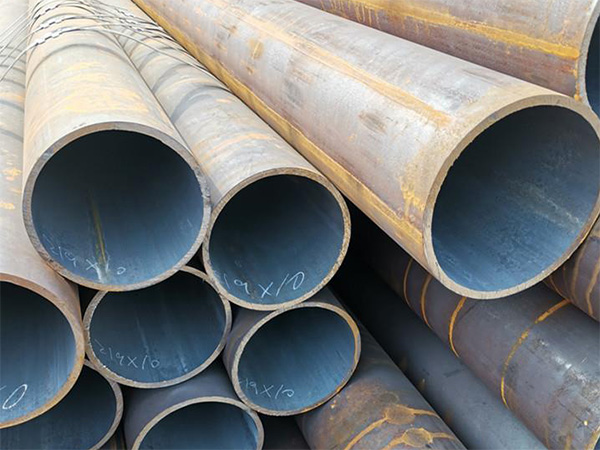
Temperature Effects on Material Properties
The elevated-temperature processing conditions leave a lasting imprint on the steel's structure. During hot rolling, the steel recrystallizes continuously as it deforms at temperature. This repeated recrystallization refines the grain structure, creating a uniform, equiaxed microstructure that provides a reliable combination of strength and toughness. The grain refinement that occurs naturally during hot working cannot be replicated through cold working alone.
After rolling, controlled cooling affects the final mechanical properties. Carbon and low-alloy steels develop a ferrite-pearlite microstructure during air cooling—a combination that delivers the ductility and weldability that most industrial applications require. For alloy grades requiring specific property profiles, the supplier may apply additional heat treatment after rolling, such as normalizing, to achieve the microstructure and mechanical properties that the applicable specification demands.
Where Hot Rolled Seamless Pipe Excels
Hot rolled seamless steel pipe demonstrates particular strength in several application categories. The structural integrity that the seamless process provides—without longitudinal welds or heat-affected zones—makes these products particularly suitable for pressure-critical service. A supplier that invests in seamless manufacturing capability typically serves customers in oil and gas transmission, chemical processing, and power generation where failure consequences are severe and predictability matters enormously.
The process economics of hot rolling favor larger diameters and heavier wall sections. As the pipe grows in size, the cost advantage of seamless production narrows compared to welded alternatives, but the performance gap remains meaningful. For pipeline projects requiring NPS 16 through NPS 26 or larger, the seamless option provides burst strength margins and fatigue resistance that justify the incremental material expense for high-consequence applications.
Boiler and furnace applications represent another domain where hot-rolled seamless products dominate. Steam headers, risers, and convection section tubes operate in environments that demand reliable creep resistance at sustained elevated temperatures. The uniform microstructure that hot rolling produces provides consistent high-temperature performance that welded constructions struggle to match, particularly in the heat-affected zones adjacent to longitudinal seams.
Manufacturing Scale and Supplier Considerations
Not every manufacturer possesses the equipment needed for hot-rolled seamless production. The capital intensity of the rolling mill, the piercing apparatus, and the associated heat treatment infrastructure creates meaningful barriers to entry. Buyers benefit from understanding which facilities can actually produce these products domestically versus those that rely on imported inventory to fulfill orders.
A reputable seamless pipe supplier typically demonstrates several capabilities: in-house heat treatment capability for the grades they stock, full-body ultrasonic examination equipment to verify internal soundness, and documented quality management system registration to ISO 9001 or equivalent standards. These investments signal that the manufacturer takes quality seriously and maintains the operational discipline that consistent product conformance requires.
Lead time represents another practical consideration. Hot-rolled seamless production on standard sizes may run 8 to 14 weeks from order confirmation to ready-for-shipment status. Custom sizes or specialized grades can extend timelines significantly. Projects with aggressive schedules should confirm availability with potential suppliers early in the procurement planning phase rather than assuming that all distributors maintain ready inventory.
Comparing Hot Rolled to Other Manufacturing Routes
The industrial buyer choosing between hot-rolled seamless and alternatives must weigh dimensional precision against cost and performance. Hot-rolled products achieve moderate dimensional tolerances—suitable for most pressure piping applications but not for uses requiring tight bore control or mirror-smooth interior surfaces. Cold-drawn or cold-rolled seamless products serve those precision-critical applications, albeit at higher per-unit cost and with limitations on maximum size.
Welded alternatives, whether produced through submerged arc welding, electric resistance welding, or other processes, offer wider size ranges and often lower acquisition cost. However, the longitudinal weld seam introduces a metallurgical discontinuity that affects burst strength, fatigue life, and corrosion behavior in ways that matter for demanding applications. The supplier selection decision ultimately connects to application requirements—the right product depends on what the pipe must actually do in service.
Making the Specification Decision
Industrial buyers should anchor specification decisions in documented engineering requirements rather than habit or assumption. Design pressure, temperature range, anticipated corrosion rates, mechanical loading conditions, and expected service life each influence the appropriate product category. Once these parameters are quantified, matching them to the correct specification—ASTM A106 for high-temperature carbon steel, ASTM A335 for alloy grades, API 5L for line pipe applications—becomes straightforward.
Working with a knowledgeable supplier early in the specification development process often reveals options that generic product descriptions obscure. An experienced manufacturer representative can flag potential issues—unsuitable grades for the intended service, overly restrictive tolerances that inflate cost without proportional benefit, or missing documentation requirements that might cause inspection delays during construction. This kind of substantive technical dialogue creates value that generic procurement transactions cannot replicate.
Conclusion
Hot rolled seamless steel pipe occupies a well-defined position in the industrial tubular products landscape. The manufacturing process delivers reliable mechanical properties, eliminates longitudinal seam vulnerabilities, and serves the full range of diameters and wall thicknesses that most industrial applications require. For buyers who match products to actual service requirements rather than defaulting to the most expensive option, hot-rolled seamless often represents the pragmatic choice—combining proven performance with manufacturing economics that keep projects within budget.
Specifying correctly requires understanding both the product and the application. Procurement teams that invest time in requirement definition and supplier qualification consistently achieve better outcomes than those that treat pipe specification as a commodity transaction. The cost of specification errors—delays, rework, field failures, or safety incidents—dwarfs any procurement savings from choosing based on price alone.
Frequently Asked Questions
Q: What temperatures does hot rolled seamless steel pipe typically withstand?
A: Carbon steel hot-rolled seamless pipe per ASTM A106 performs reliably from approximately -20°F through about 800°F, depending on grade and wall thickness. Above 400°F, allowable stress begins decreasing per ASME BPVC Section II tables, requiring thicker walls or alloy grades for equivalent pressure ratings. The supplier should confirm specific temperature capability against the applicable specification for the intended application.
Q: How does the hot rolling process affect the steel's internal structure?
A: Hot rolling causes repeated recrystallization of the steel grain structure at elevated temperature, producing a refined, uniform equiaxed microstructure. This grain refinement improves toughness and ductility compared to as-cast structures. The ferrite-pearlite microstructure that develops during controlled air cooling provides the combination of strength and weldability that most industrial applications require.
Q: What quality tests should a buyer require for hot rolled seamless pipe?
A: Standard requirements include tensile testing (yield, tensile, elongation), flattening or guided bend testing, and hydrostatic pressure testing per the applicable ASTM specification. For critical applications, supplementary ultrasonic examination, eddy current testing, or Charpy impact testing at design temperature provides additional assurance. Mill Test Reports documenting all required testing should accompany each shipment.
Q: Why does hot rolled seamless pipe sometimes cost more than welded alternatives?
A: Hot-rolled seamless production requires specialized equipment—reheat furnaces, piercing mills, elongation stands, and associated infrastructure—that carries significant capital investment and operating cost. The seamless process also typically produces shorter lengths than welded production methods, increasing handling and transportation frequency. However, for demanding applications, the performance advantages often justify the cost differential.
Q: Can hot rolled seamless pipe be used in structural applications?
A: Yes—structural pipe and tube applications frequently specify hot-rolled seamless products. Hollow structural sections, structural columns, and mechanical tubing applications benefit from the uniform wall and consistent mechanical properties that the seamless manufacturing process provides. ASTM A500 covers cold-formed welded and seamless carbon steel structural tubing with specifications appropriate for structural applications.
References
ASTM International. (2024). ASTM A106/A106M-24: Standard Specification for Seamless Carbon Steel Pipe for High-Temperature Service. West Conshohocken, PA.
ASM International. (2023). Metallurgy of Steel Processing. Materials Park, OH.
ASM International. (2023). Properties and Selection: Irons, Steels, and High-Performance Alloys (Vol. 1). Materials Park, OH.
Callister, W.D. & Rethwisch, D.G. (2023). Materials Science and Engineering: An Introduction (10th ed.). Hoboken, NJ: Wiley.
Kalpakjian, S. & Schmid, S.R. (2024). Manufacturing Engineering and Technology (8th ed.). Singapore: Pearson.