

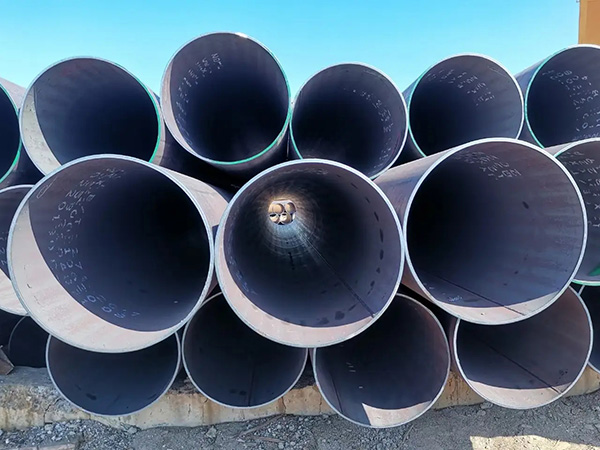
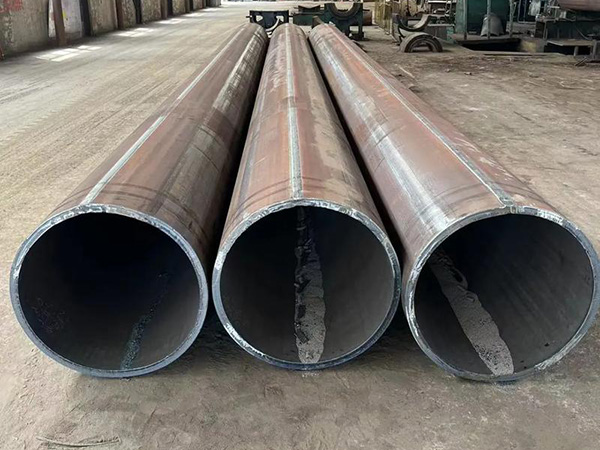
For medium-diameter welded steel pipe in moderate-pressure service, ERW steel pipe represents the production method that most industrial procurement professionals encounter most frequently. Electric Resistance Welded pipe combines high production rates, economical material utilization, and a weld seam that—when properly manufactured—approaches the mechanical properties of the parent material. Understanding the manufacturing process, the features that distinguish modern ERW from earlier generations, and the application range where ERW provides the best balance of performance and cost helps buyers specify the right pipe for their requirements and verify that delivered material meets those specifications.
The ERW Manufacturing Process
ERW pipe production begins with steel coil—flat-rolled strip material called skelp that is fed from an uncoiler into a continuous forming line. The skelp passes through a series of forming rolls that progressively shape the flat strip into a cylindrical tube with the longitudinal edges meeting at the top. The specific forming approach varies: roll forming uses a sequence of shaped rolls; cage forming uses a combination of rolls and cages; and the most modern lines use roll forming with edge bending preparation to ensure the seam edges meet with precise alignment.
As the formed tube reaches the welding station, the seam edges are heated using high-frequency electrical current. Modern ERW lines operate at 100 to 400 kHz, using either contact-based systems (sliding contacts delivering current directly to the seam edges) or induction-based systems (an induction coil surrounding the tube inducing current in the seam). The high-frequency current concentrates at the seam edges due to the skin effect and proximity effect, heating the steel to forging temperature—typically 1,300 to 1,400°C—rapidly and with minimal heat input to the surrounding material.
Once the seam edges reach forging temperature, squeeze rolls apply pressure that forges the heated edges together, creating a solid-state bond without filler metal. The upset metal extruded from the weld zone is typically trimmed off by an internal and external bead scraper, producing a relatively smooth weld flash. The welded tube then passes through sizing rolls that calibrate the final diameter and roundness before the continuous tube is cut to ordered lengths.
High-Frequency Versus Low-Frequency: Why the Difference Matters
The transition from low-frequency (60 Hz) to high-frequency (100 kHz+) ERW welding, which occurred progressively from the 1970s through the 1990s, fundamentally changed the quality capability of ERW steel pipe. Low-frequency welding heated a wide band of metal on each side of the seam, producing a broad heat-affected zone with significant grain coarsening and property degradation. The resulting weld seam exhibited lower toughness than the parent material, creating a weak link that limited ERW pipe's acceptance for demanding applications.
High-frequency welding concentrates the heat in a very narrow zone at the seam edges—typically 0.5 to 2 millimeters wide. This narrow heat-affected zone preserves the base material microstructure and properties immediately adjacent to the weld, producing a bond whose mechanical properties can approach those of seamless pipe when properly processed. The improvement in weld quality, combined with modern seam annealing practices that normalize the weld zone microstructure, has enabled ERW pipe to qualify for API 5L PSL 2 service and for applications that earlier generations of ERW could not reliably serve.
Buyers should confirm that pipe is produced using high-frequency welding. The specification or Mill Test Report should reference HF ERW or HFW (high-frequency welded). Pipe produced using older low-frequency processes—sometimes still encountered in material from mills with older equipment or in surplus inventory—should be evaluated carefully for applications involving pressure, cyclic loading, or toughness requirements.
Key Features of ERW Steel Pipe
Forge Weld Microstructure
Unlike submerged arc welding, which deposits filler metal into a prepared groove, ERW creates a forge bond between the seam edges. The microstructure of a properly executed HF ERW weld resembles the parent material more than a cast weld deposit. When supplemented with seam annealing—reheating the weld zone to normalize the microstructure—the weld zone properties can match the base material in tensile strength, yield strength, and toughness. This metallurgical similarity is what enables ERW pipe to qualify for demanding specifications.
Narrow Heat-Affected Zone
The concentrated heating of high-frequency welding produces a heat-affected zone dramatically narrower than that of submerged arc or low-frequency welding. This narrow HAZ means that the material immediately adjacent to the weld retains its original microstructure and properties, avoiding the broad softened or hardened bands that earlier welding methods produced. For toughness-critical applications, the narrow HAZ provides better overall performance because the fracture path must traverse material with uniform properties rather than transitioning through degraded zones.
High Production Rate
ERW production lines operate continuously—feeding coil, forming, welding, sizing, and cutting in a single uninterrupted flow. Production rates of 10 to 30 meters per minute are typical, depending on diameter and wall thickness. This throughput advantage makes ERW the most economical welded pipe production method for medium diameters, where the high volume justifies the line's capital investment. The cost advantage over LSAW and seamless production is most pronounced in standard sizes and grades where competition is robust.
Dimensional Consistency
Continuous production through calibrated rolls produces ERW pipe with consistent dimensions along the full length. Outside diameter variation of plus or minus 0.5 to 0.75 percent is standard, with wall thickness variation of plus or minus 7.5 to 10 percent reflecting the coil thickness variation. For many commercial applications, this consistency is adequate. For applications requiring tighter tolerances, additional sizing or expanding operations can improve dimensional precision, though at added cost.
Size Range and Availability
ERW steel pipe is commercially available in diameters from approximately NPS 2 (60 mm) through NPS 24 (610 mm), with wall thicknesses from standard through extra-strong schedules. The most economical production range is NPS 4 through NPS 16, where high production volumes, standard coil availability, and mature manufacturing infrastructure combine to produce competitive pricing.
Below NPS 2, ERW faces competition from seamless production for precision applications and from butt-welded or other thin-wall welded methods for commodity applications. Above NPS 24, the coil width limitations of ERW forming make LSAW or SSAW production more practical. Within the NPS 2 to NPS 24 range, ERW provides the primary economical alternative to seamless pipe for welded construction.
Applications Where ERW Pipe Performs
Oil and Gas Gathering and Distribution
ERW pipe serves gathering lines that transport produced fluids from wellheads to processing facilities, and distribution lines that deliver refined products to end users. For moderate-pressure service in non-sour, non-corrosive applications, ERW pipe produced to API 5L PSL 2 provides adequate performance at lower cost than seamless alternatives. The key is matching the service conditions to ERW's capabilities: moderate pressure, non-critical cyclic loading, and environments where weld seam integrity is not the primary concern.
Water and Wastewater Systems
Municipal water distribution, wastewater transmission, and industrial water systems represent major ERW applications. These services typically operate at low to moderate pressures with minimal cyclic loading, making ERW's cost advantage fully applicable. ASTM A53 Grade B ERW pipe serves the majority of these applications, with A135 and A795 addressing specific fire protection and sprinkler system requirements.
Structural and Piling Applications
ERW pipe serves structural applications including columns, braces, handrails, and piling where pressure containment is not the primary function. ASTM A500 covers cold-formed welded and seamless carbon steel structural tubing in round, square, and rectangular shapes. ERW structural tubing provides economical load-carrying capability for buildings, platforms, supports, and foundation systems where the weld seam's presence does not compromise structural integrity.
Fencing, Sign Posts, and Agricultural Applications
For non-critical applications where strength and durability matter more than pressure capability, ERW pipe provides economical tubular products for fencing, sign supports, agricultural equipment, and similar service. These applications typically use standard-grade ERW pipe with minimal testing requirements, reflecting the low failure consequences and the economic priority that characterizes these end uses.
Quality Verification for ERW Pipe
Verification of ERW steel pipe quality requires specific attention to the weld seam. The forge bond, while metallurgically sound when properly executed, must be tested to confirm that the weld is continuous and free from defects:
Ultrasonic testing of the weld seam along its full length detects internal defects—lack of fusion, porosity, and cracks
Hydrostatic testing verifies leak-tightness under pressure
Weld seam tensile testing confirms that the forge bond achieves the specified tensile strength
Guided bend testing subjects the weld to bending deformation that reveals ductility deficiencies
Charpy impact testing (for PSL 2) verifies weld zone toughness at the specified test temperature
Mill Test Reports should document all test results with actual values. The weld seam test results should be compared against the base material properties—significant differences indicate weld quality issues that may affect performance in service. Buyers should also confirm that the manufacturing process is HF ERW rather than the older low-frequency process, which produces inferior weld quality.
Conclusion
ERW steel pipe provides the economical welded pipe solution for medium-diameter applications across oil and gas, water, structural, and general industrial service. High-frequency welding, with its narrow heat-affected zone and forge-bond microstructure, has transformed ERW from the marginal quality perception of earlier low-frequency production into a reliable specification for moderate-pressure and structural applications. The production efficiency of continuous ERW lines translates into cost advantages that benefit buyers across the wide range of applications where ERW's performance characteristics are adequate.
Successful ERW procurement requires matching the pipe type to application requirements—ERW for moderate-pressure service where weld seam presence is acceptable, seamless for the most demanding services. Buyers who verify HF welding process, review weld seam test results, and specify complete requirements consistently achieve reliable installations. For projects requiring medium-diameter pipe in standard grades, consulting with a manufacturer who produces ERW pipe to API 5L or ASTM specifications provides the supply capability and technical guidance that efficient procurement depends upon.
FAQ
Q: What does ERW stand for and how is the weld created?
A: ERW stands for Electric Resistance Welded. The weld is created by applying high-frequency electrical current to the seam edges of a formed tube, heating the steel to forging temperature. Squeeze rolls then press the heated edges together, creating a solid-state forge bond without filler metal. The process produces a narrow heat-affected zone with mechanical properties that approach the parent material when properly executed.
Q: Is ERW pipe safe for pressure applications?
A: ERW pipe produced to API 5L PSL 2 or equivalent specifications, using high-frequency welding with proper testing, is safe for moderate-pressure applications. The weld seam undergoes ultrasonic testing, hydrostatic testing, tensile testing, and impact testing to verify integrity. For very high pressure, severe cyclic loading, or sour service where weld seam integrity is critical, seamless or LSAW pipe may be more appropriate.
Q: What is the difference between HF ERW and old-style ERW pipe?
A: High-frequency (HF) ERW operates at 100 to 400 kHz, concentrating heat in a narrow zone (0.5 to 2 mm) at the seam edges. Old low-frequency (60 Hz) ERW heated a wide band, producing a broad heat-affected zone with degraded properties. HF ERW produces weld quality approaching seamless pipe; low-frequency ERW has inferior toughness and is no longer specified for demanding applications.
Q: What sizes is ERW steel pipe available in?
A: ERW pipe is commercially available from approximately NPS 2 (60 mm) through NPS 24 (610 mm), with wall thicknesses from standard through extra-strong schedules. The most economical range is NPS 4 through NPS 16, where production volumes are highest and manufacturing infrastructure is most mature. Below NPS 2 or above NPS 24, other production methods become more practical.
Q: Can ERW pipe be galvanized or coated for corrosion protection?
A: Yes, ERW pipe can be hot-dip galvanized per ASTM A53 Type F or A123, or coated with fusion-bonded epoxy, three-layer PE, or other pipeline coating systems. Galvanizing provides atmospheric corrosion protection for exposed applications; FBE and 3LPE coatings provide buried service corrosion protection for pipeline applications. The coating selection should match the service environment and design life requirements.
References
American Petroleum Institute. (2024). API Spec 5L, 47th Edition: Specification for Line Pipe. Washington, DC.
ASTM International. (2024). ASTM A53/A53M-24: Standard Specification for Pipe, Steel, Black and Hot-Dipped, Zinc-Coated, Welded and Seamless. West Conshohocken, PA.
ASTM International. (2024). ASTM A500/A500M-24: Standard Specification for Cold-Formed Welded and Seamless Carbon Steel Structural Tubing in Rounds and Shapes. West Conshohocken, PA.
American Welding Society. (2023). AWS Welding Handbook (10th ed., Vol. 2): Welding Processes. Miami, FL.
Kim, Y.K. & Park, J.S. (2023). "Weld Quality Assessment in High-Frequency ERW Pipe Manufacturing." Journal of Manufacturing Processes, 89, 45-59.