

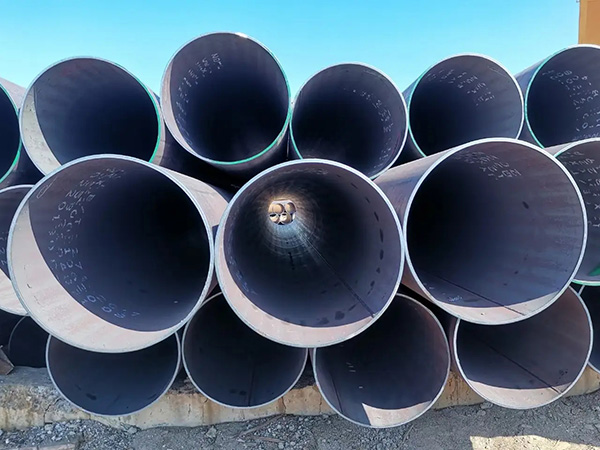
Welded Steel Pipe
Welded Steel Pipe,commonly shortened to welded pipe,is a cylindrical steel tube manufactured by forming flat steel strips/coils into a round(or shaped)profile and permanently joining the abutting edges via a dedicated welding process.Unlike...
Welded Steel Pipe,commonly shortened to welded pipe,is a cylindrical steel tube manufactured by forming flat steel strips/coils into a round(or shaped)profile and permanently joining the abutting edges via a dedicated welding process.Unlike seamless steel pipes,which are extruded from solid billets,welded pipes feature a visible or non-visible weld seam,and modern welding technologies have made the seam strength comparable to the base metal in most cases.It is typically supplied in standard lengths of 6m or 12m,with customizable lengths for specific projects.
Main Types&Welding Processes
ERW(Electric Resistance Welded Pipe):High-frequency(HF)ERW is the most widely used method.The steel strip is roll-formed,and the edges are heated and fused by high-frequency current without additional filler metal.It offers excellent dimensional accuracy,uniform wall thickness,and high production efficiency,ideal for small to medium diameters(common in water,gas,and structural uses).
LSAW(Longitudinal Submerged Arc Welded Pipe):A straight-seam process using submerged arc welding for large-diameter,thick-walled pipes.It is suitable for high-pressure fluid transmission(oil,gas,water conservancy)and heavy structural applications.
SSAW(Spiral Submerged Arc Welded Pipe):The steel strip is formed at a spiral angle,with double-sided submerged arc welding.It can produce very large diameters from narrower strips,has good pressure-bearing capacity,and is a top choice for long-distance oil&gas pipelines and offshore engineering.
Other variants include galvanized welded pipes(hot-dip/electro-galvanized for anti-corrosion),square/rectangular welded pipes for construction frames,and stainless steel welded pipes for chemical/food-grade applications.
Core Manufacturing Process
Material Preparation:Select carbon steel,high-strength low-alloy(HSLA)steel,or stainless steel strips;inspect for chemical composition and mechanical properties.
Forming:Roll the strip into the desired shape via a series of forming rollers(ERW for straight seam,spiral coiling for SSAW).
Welding:Apply ERW,SAW,or laser welding as needed;HF ERW heats edges to molten state for fusion,while SAW uses granular flux to protect the weld pool.
Post-Weld Treatment:Remove weld beads,perform heat treatment to eliminate residual stress,conduct non-destructive testing(ultrasonic,X-ray,pressure tests)to ensure quality.
Finishing:Cut to length,surface coating(galvanizing,epoxy,3PE),marking,and packaging.
Key Advantages
Cost-Effective:Lower equipment investment,faster production,and more economical especially for large-diameter pipes compared to seamless alternatives.
Wide Size Range:Can be produced in diameters from a few millimeters up to several meters,with flexible wall thickness options.
Dimensional Precision:Easier to control consistent wall thickness and outer diameter tolerances.
High Customization:Available in round,square,rectangular,and other special profiles;various surface treatments to enhance corrosion resistance.
Typical Applications
Energy Sector:Long-distance oil,natural gas,and water transmission pipelines(API 5L ERW/SSAW pipes).
Construction&Infrastructure:Structural columns,scaffolding,bridge piers,piling pipes,and fencing.
Municipal Engineering:Water supply,sewage,and heating networks(ASTM A53,EN 10217 pipes).
Mechanical&Industrial:Conduits,machine frames,automotive exhaust systems,and fluid pipes in chemical plants.
International Standards
API 5L:Global standard for oil and gas line pipes.
ASTM A53:Standard for black and hot-dipped galvanized welded steel pipes for pressure and mechanical uses.
EN 10217:European standard for welded steel tubes for pressure purposes.
GB/T 3091:Chinese standard for low-pressure liquid-transport welded steel pipes.
Welded vs.Seamless Pipes
Welded pipes excel in cost efficiency,large-diameter availability,and production speed,making them suitable for mass projects like pipelines and construction.Seamless pipes are preferred in extremely high-pressure,high-temperature,or ultra-critical environments(e.g.,boiler tubes)where the absence of a seam is required.