

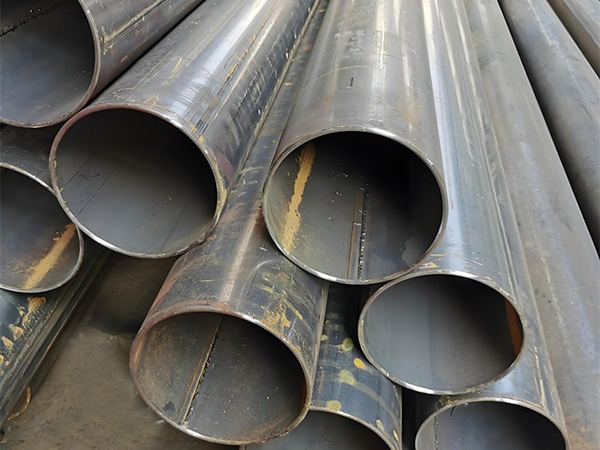
Carbon Steel Welded Pipe
Carbon Steel Welded Pipe is a widely used tubular product made by rolling carbon steel plates or strips into a cylindrical shape and welding the longitudinal or spiral seam.It is produced through various welding processes such as Electric R...
Carbon Steel Welded Pipe is a widely used tubular product made by rolling carbon steel plates or strips into a cylindrical shape and welding the longitudinal or spiral seam.It is produced through various welding processes such as Electric Resistance Welding(ERW),Submerged Arc Welding(SAW),High-Frequency Welded(HFW),and Laser Welding,offering a cost-effective and reliable solution for fluid transportation,structural support,and general engineering applications.
Main Features
Cost-effective:Lower production cost compared with seamless steel pipes,suitable for large‑scale projects.
Stable performance:Uniform wall thickness,good roundness,and consistent mechanical properties.
Wide size range:Available in small to large diameters,with various wall thicknesses and lengths.
Easy processing:Can be cut,bent,flanged,threaded,and coated conveniently.
Good weldability:Made of carbon steel,compatible with most welding and connection methods.
Common Manufacturing Processes
ERW/HFW Pipe:High‑frequency electric resistance welded,mainly for medium and small diameters,used in water,gas,and structural pipes.
SAW Pipe(LSAW&SSAW):Submerged arc welded,for large‑diameter,thick‑wall pipes used in high‑pressure oil and gas pipelines.
LSW Pipe:Longitudinal welded pipes for general industrial and construction use.
Material&Standards
Common materials:ASTM A53,API 5L Grade B,Q235,Q355,ST37,ST52
Typical standards:
API 5L
ASTM A53/A252
EN 10217
GB/T 3091,GB/T 9711
Applications
Water supply and drainage pipelines
Oil,natural gas,and fuel transportation
Municipal engineering and pipeline networks
Structural pipe piles for bridges,ports,and buildings
Industrial process piping
Scaffolding,steel structures,and mechanical parts
Advantages Over Seamless Pipe
Lower price
Higher production efficiency
More stable dimensional accuracy
More suitable for mass production and large‑diameter specifications