

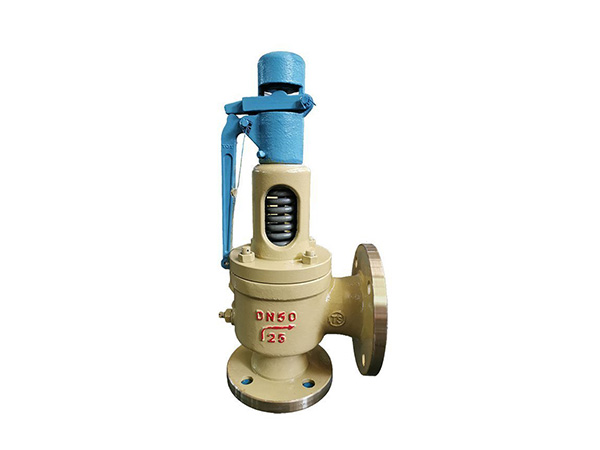
Safety Valve
A safety valve is an essential protective device widely used in industrial systems,designed to automatically release excess pressure from vessels,pipelines,or equipment when the internal pressure exceeds a preset safe limit.It serves as the...
A safety valve is an essential protective device widely used in industrial systems,designed to automatically release excess pressure from vessels,pipelines,or equipment when the internal pressure exceeds a preset safe limit.It serves as the last line of defense against overpressure,preventing catastrophic failures such as explosions,equipment damage,or potential safety hazards to personnel and the environment.Unlike control valves that perform continuous modulating control,safety valves operate in an on-off manner,activating only when the pressure reaches the set point and closing once the pressure returns to a safe level.
The basic structure of a safety valve comprises four key components:valve body,disc,spring,and bonnet.The valve body connects to the equipment or pipeline,providing a passage for pressure release.The disc,seated tightly against the valve seat under normal conditions,blocks the flow of fluid or gas.The spring,the core pressure-control element,applies a pre-determined force to keep the disc closed;its tension is calibrated to the desired set pressure.The bonnet houses the spring and adjustment mechanism,allowing for precise setting and maintenance of the valve’s operating pressure.Some safety valves also include a lever or auxiliary pilot to enhance control and reliability.
Safety valves are categorized into various types based on their design,operation,and application.By actuation method,they are divided into spring-loaded,pilot-operated,and weight-loaded safety valves.Spring-loaded valves are the most common,relying on spring force for pressure control and suitable for most industrial scenarios.Pilot-operated valves use a small pilot valve to control the main valve,ideal for high-pressure,large-capacity systems.Weight-loaded valves,which use a weighted lever to maintain closure,are typically used in low-pressure,stationary applications.By material,they can be made of carbon steel,stainless steel,or special alloys to resist corrosion and high temperatures.
The working principle of a safety valve is simple yet reliable:under normal operating conditions,the spring force presses the disc against the valve seat,keeping the valve closed.When the internal pressure of the protected equipment exceeds the preset set pressure,the pressure force acting on the disc overcomes the spring force,lifting the disc off the seat.This opens the valve,allowing excess fluid or gas to be discharged into the atmosphere or a recovery system,reducing the internal pressure.Once the pressure drops back to the safe range,the spring force pushes the disc back onto the seat,closing the valve and resuming normal operation.
Safety valves are widely applied in oil&gas,chemical,power generation,boiler,and pharmaceutical industries,where pressure control is critical.Their performance and reliability are regulated by international standards(e.g.,ASME,API)to ensure compliance with safety requirements.Regular inspection,calibration,and maintenance are essential to keep safety valves in good working condition,as any malfunction could lead to severe accidents.Modern safety valves are also integrated with monitoring devices to provide real-time status feedback,further enhancing industrial safety management.