

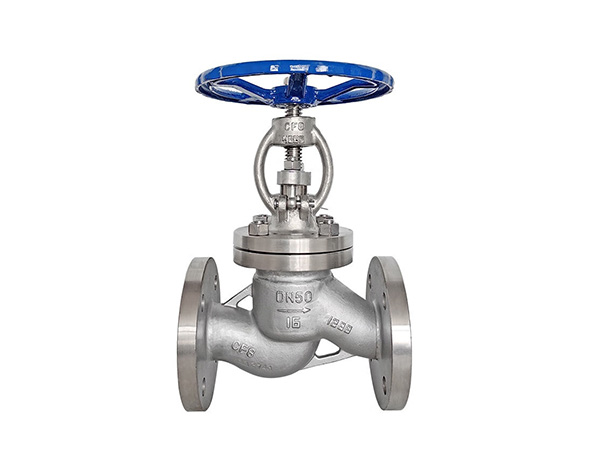
Globe Valve
A globe valve is a linear-motion control valve widely used for regulating,throttling,and isolating fluid flow in pipelines.Recognized for its excellent throttling performance and reliable shutoff capability,it is one of the most versatile v...
A globe valve is a linear-motion control valve widely used for regulating,throttling,and isolating fluid flow in pipelines.Recognized for its excellent throttling performance and reliable shutoff capability,it is one of the most versatile valves in industrial systems.Unlike ball valves or gate valves,which are primarily for on–off service,globe valves excel in accurately adjusting flow rates,making them essential in applications requiring precise pressure and flow control.
The design of a globe valve centers on a movable plug(disc)that moves up and down against a stationary seat inside a somewhat globular-shaped body.Fluid enters one side of the valve,changes direction as it passes the seat,and exits on the opposite side.This tortuous flow path creates moderate pressure drop but enables excellent control characteristics.When the valve is fully open,the plug is lifted completely,allowing flow;as the plug lowers,it restricts the flow area,gradually reducing flow rate.
Globe valve plugs come in various profiles,including flat,tapered,and needle-shaped,each designed for specific control performance.Tapered plugs offer smooth,linear throttling,while needle plugs provide extremely fine adjustment for low-flow or high-precision systems.The valve stem can be operated manually via a handwheel,or automatically with electric,pneumatic,or hydraulic actuators for remote and automated process control.
Common classifications include Z-type,Y-type,and angle globe valves.Z-type is the standard design,widely used for general service.Y-type valves reduce flow resistance and are suitable for high-velocity or erosive fluids.Angle globe valves change flow direction by 90 degrees,minimizing turbulence and simplifying piping layouts.Rising stem designs provide clear visual indication of valve position,supporting safer operation.
Materials are selected based on fluid type,temperature,and pressure.Common body materials include cast iron,ductile iron,carbon steel,stainless steel,and bronze.Seating surfaces are often hardened or alloy-overlaid for wear resistance,while gaskets and packing use PTFE,graphite,or other high-performance materials to ensure tight sealing under steam,water,oil,gas,and chemical conditions.
Globe valves are extensively used in power plants,oil and gas facilities,chemical processing,HVAC systems,boiler feed lines,and process piping.Their key advantages include superior throttling control,reliable sealing,easy maintenance,and suitability for high-temperature and high-pressure environments.However,they generally have higher pressure loss compared to full-bore gate or ball valves.
Proper selection depends on required flow characteristics,pressure class,line size,and medium.Regular maintenance of packing and seating surfaces ensures long service life and prevents leakage.With their balanced performance between control and isolation,globe valves remain indispensable in modern fluid systems where accurate regulation and dependable shutoff are critical.