

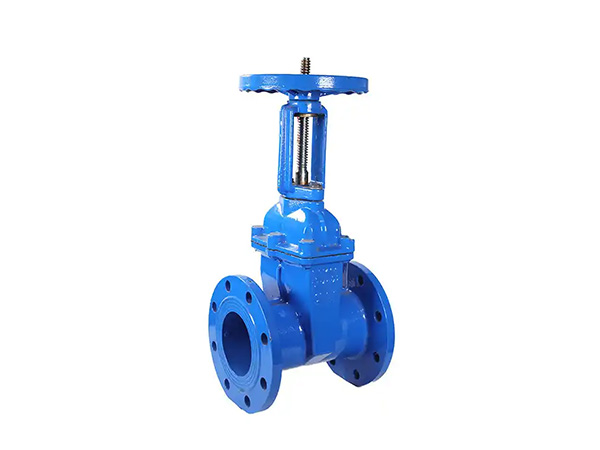
Gate Valve
A gate valve is a linear-motion valve primarily designed for fully open or fully closed service in fluid pipelines.It controls flow by raising or lowering a rectangular or wedge-shaped gate that blocks or permits passage through the valve b...
A gate valve is a linear-motion valve primarily designed for fully open or fully closed service in fluid pipelines.It controls flow by raising or lowering a rectangular or wedge-shaped gate that blocks or permits passage through the valve body.Unlike throttling valves,gate valves are not intended for flow regulation;their main function is to provide tight,bubble-tight isolation in water,oil,gas,steam,and industrial process systems.
The operating principle of a gate valve is simple and robust.A handwheel,gear operator,or actuator turns a stem,which moves the gate vertically.When fully open,the gate retracts completely into the bonnet,creating an unobstructed,full-bore flow path with very low pressure drop.When closed,the gate seats firmly against the valve body,creating a secure seal to prevent fluid passage.This design makes gate valves ideal for applications requiring unrestricted flow and reliable shutoff.
Gate valves are commonly classified into two main types:rising stem and non-rising stem.Rising stem gate valves have a stem that moves upward with the gate,clearly indicating valve position and facilitating visual inspection.They are widely used in industrial plants,power stations,and water treatment facilities.Non-rising stem gate valves have a fixed stem height,with the gate moving along threaded sections,making them suitable for underground installations,marine systems,and spaces with limited vertical clearance.
Another key distinction is the gate design.Wedge gate valves use a tapered,two-seat wedge that provides excellent sealing under pressure and minimizes leakage.They are suitable for high-pressure and high-temperature applications such as steam lines and oil pipelines.Parallel gate valves feature flat gates and are often used in low-pressure systems,slurries,and wastewater applications.
Materials are selected based on pressure,temperature,and fluid compatibility.Common body materials include cast iron,ductile iron,carbon steel,stainless steel,and alloy steel.Sealing surfaces may be hardfaced with stellite or other wear-resistant alloys to extend service life.Gaskets and packing are made from graphite,PTFE,or aramid fibers to withstand extreme operating conditions.
Gate valves are widely applied across industries including oil and gas,petrochemical,power generation,water supply,wastewater treatment,and marine engineering.Their advantages include low flow resistance,simple structure,reliable sealing,and suitability for both low and high-pressure systems.However,they require more operating time compared to quarter-turn valves and are not recommended for frequent cycling or throttling.
Proper installation and maintenance are essential to ensure long-term performance.Regular inspection of stem packing,gate seating,and operating mechanisms helps prevent leakage and premature wear.With their durable construction and dependable shutoff capability,gate valves remain one of the most fundamental and widely used valves in modern fluid control systems.