

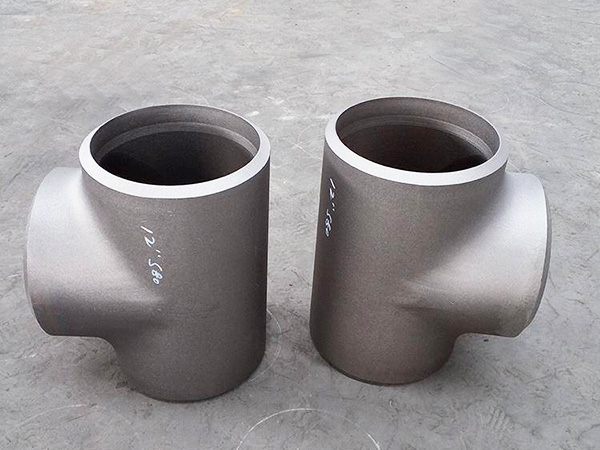
Pipe Fitting Tee
A Pipe Fitting Tee(commonly called a pipe tee)is a fundamental,T-shaped piping component designed to split a single fluid/gas flow into two paths or merge two flows into one,creating a 90°branch from the main pipeline run.It features three...
A Pipe Fitting Tee(commonly called a pipe tee)is a fundamental,T-shaped piping component designed to split a single fluid/gas flow into two paths or merge two flows into one,creating a 90°branch from the main pipeline run.It features three connection ports:two aligned opposite each other form the run(main line),and the perpendicular one is the branch.Widely adopted across industrial,commercial,and residential piping systems,tees are available in diverse sizes,materials,connection styles,and pressure ratings to meet specific application needs.
Types of Pipe Tees
Equal Tee(Straight Tee):All three ports have the same nominal diameter,ideal for balanced flow splitting/merging in uniform pipeline networks.
Reducing Tee(Unequal Tee):The branch diameter differs from the run diameter(e.g.,4”×4”×3”),used to connect smaller branch pipes to larger main lines while minimizing turbulence.
Specialty Tees:Lateral tees(45°branch for smoother flow),reinforced tees(for high-pressure/high-temperature services),and diverter tees(for hydronic heating systems).
Connection Methods
Butt Weld(BW):Ends are beveled for full-penetration welding;suitable for large-diameter,high-pressure industrial pipelines(ASME B16.9).
Socket Weld(SW):Pipes are inserted into recessed sockets and welded;common for small-bore,high-pressure systems(ASME B16.11).
Threaded:NPT/NPTF threads for quick assembly/disassembly;often used in low-to-medium pressure plumbing and instrumentation lines.
Flanged:Bolted flange connections for easy maintenance in large industrial systems.
Materials
Carbon Steel(ASTM A234 WPB):Cost-effective,high-strength for oil,gas,chemical,and power industries.
Stainless Steel(304/316/316L):Excellent corrosion resistance for food,pharmaceutical,marine,and corrosive fluid applications.
Copper/Brass:For plumbing,HVAC,and potable water systems due to good thermal conductivity and anti-biofouling properties.
Plastics(PVC,CPVC,PP,HDPE):Lightweight,corrosion-resistant,and affordable for water treatment,irrigation,and low-pressure systems.
Key Standards&Sizing
Common industry standards include ASME B16.9(wrought butt-welding fittings),ASME B16.11(forged socket-weld/threaded fittings),EN 10253,DIN 2605,and GB/T 12459.Sizing is specified by Nominal Pipe Size(NPS)or Diameter Nominal(DN),with wall thickness schedules(STD,SCH40,SCH80,XS,XXS).Reducing tees are ordered as Run×Run×Branch(e.g.,6”×6”×4”).
Applications
Oil&Gas:Pipeline headers,wellhead connections,and refinery process piping.
Chemical Processing:Transport of corrosive fluids,two-phase mixtures,and reactor loops.
Water&Wastewater:Municipal water distribution,sewage treatment plant piping networks.
Plumbing&HVAC:Domestic water lines,heating/cooling branch connections,fire protection systems.
Power Generation:Steam and cooling water pipelines in thermal/nuclear power plants.
Installation&Selection Tips
Match the tee material to the fluid type,temperature,pressure,and environmental conditions to prevent corrosion or failure.
Ensure alignment during welding to avoid internal flow restrictions and stress concentrations.
For high-pressure services,verify reinforcement calculations(per ASME B31.3)or select integrally reinforced tees.