

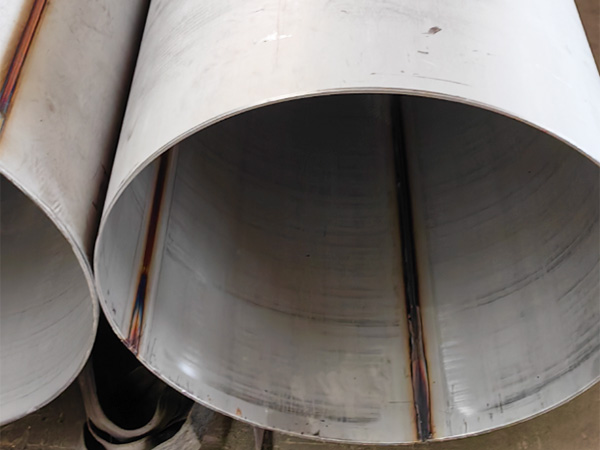
Large Diameter Stainless Steel Pipe
Large Diameter Stainless Steel Pipe(LDSSP)is typically defined as pipe withOutside Diameter(OD)≥12 inches(304.8 mm)(commonly≥16 inches/406 mm for heavy industrial use,per ASTM industry conventions).It is engineered for high-flow,high-pr...
Large Diameter Stainless Steel Pipe(LDSSP)is typically defined as pipe withOutside Diameter(OD)≥12 inches(304.8 mm)(commonly≥16 inches/406 mm for heavy industrial use,per ASTM industry conventions).It is engineered for high-flow,high-pressure,and long-service-life applications,available in seamless and welded constructions,with austenitic(304/304L,316/316L),duplex(2205,2507),and super austenitic(904L,310S)grades to match aggressive operating environments.It relies on a passive chromium oxide layer for exceptional corrosion resistance,while its robust wall thicknesses ensure structural integrity under extreme temperatures and pressures.
Definition,Grades&Standards
1.Size Thresholds:OD from 12”(304.8 mm)up to 60”(1524 mm)and beyond;wall thicknesses(WT)from SCH 10S up to SCH 160,XS,XXS,or custom heavy walls(up to 70+mm).
2.Common Grades:
-General Service:304,304L(low carbon for welding,anti-intergranular corrosion)
-Chloride/Marine:316,316L,2205 Duplex
-High Temperature:321(Ti-stabilized),310S
-Extreme Corrosion:904L,2507 Super Duplex
3.Key International Standards:ASTM A312(seamless/welded),ASTM A778(welded),ASTM A358(electron beam welded),EN 10216-5,JIS G3459,GB/T 14976.
Manufacturing Types&Process Differences
Seamless Large Diameter Pipe is produced through hot piercing and hot rolling/expanding from billets,followed by heat treatment for grain refinement.Its key advantages include no weld defects,higher pressure rating,and better fatigue resistance,though it comes with limitations such as higher cost,size constraints,and longer lead times.It is best suited for high-pressure refinery lines,power plant superheaters,and critical offshore piping.
Welded Large Diameter Pipe is manufactured by forming plates or coils,followed by precision welding(including ERW,TIG,LSAW,and Spiral Weld methods),pickling/passivation,and hydrostatic/X-ray inspection.It offers advantages like lower cost for very large OD,uniform wall thickness,flexible lengths,and scalable production,but its quality is critical to weld integrity and requires strict non-destructive testing(NDT).It is ideal for municipal water/sewage systems,seawater desalination plants,chemical plant headers,and architectural structures.
Core Mechanical&Corrosion Performance
-Annealed Mechanical Values(304/304L):Yield Strength≥205 MPa;Tensile Strength≥515 MPa;Elongation≥40%.Duplex grades(2205)offer approximately double the yield strength compared to austenitic grades.
-Heat Resistance:304/316 grades support continuous service up to 870°C(1600°F),while 310S can withstand temperatures up to 1150°C.
-Corrosion Protection:The passive oxide film on the surface self-heals in oxygenated environments;prolonged exposure to high-concentration chlorides should be avoided(316L/duplex grades are recommended for such scenarios).
-Magnetism:Austenitic grades are non-magnetic in the annealed state,with slight magnetism after cold working or forming;duplex grades are inherently magnetic.
Primary Applications
-Energy&Petrochemical:Refinery process lines,offshore platforms,LNG terminals,power plant cooling/steam systems
-Water&Wastewater:Municipal potable water mains,seawater desalination plants,industrial wastewater treatment
-Chemical&Pharmaceutical:Acid/alkali transfer headers,clean-in-place(CIP)systems,reactor vessels
-Architecture&Infrastructure:Bridge components,large-scale building facades,handrails for stadiums
-Marine Engineering:Shipbuilding,coastal desalination,port infrastructure.
Quality Control&Installation Notes
1.Mandatory Inspections:Hydrostatic pressure testing,X-ray/ultrasonic weld testing,pickling/passivation,dimensional verification,material certification(MTR).
2.Connection Methods:Flange welding,butt welding,grooved joints;use matching filler metals(e.g.,ER308L for 304L,ER316L for 316L).
3.Avoidances:High-chloride stagnant conditions;improper post-weld heat treatment for carbon-sensitive grades.