

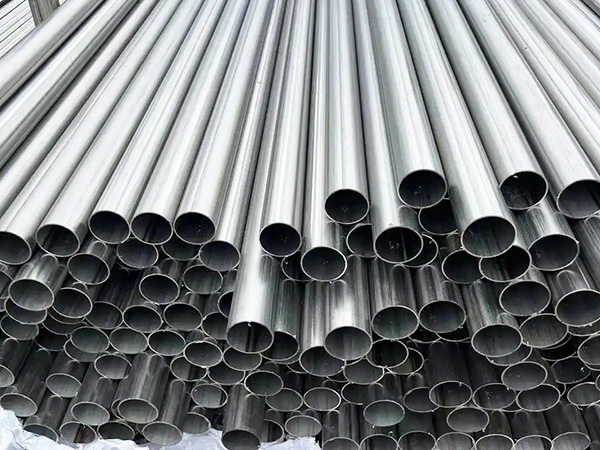
Corrosion Resistant Stainless Steel Pipe
Corrosion Resistant Stainless Steel Pipe is a premium,iron-based alloy piping solution defined by a minimum of 10.5%chromium content,with nickel,molybdenum,nitrogen,and other alloying elements added to enhance its anti-corrosive and mechani...
Corrosion Resistant Stainless Steel Pipe is a premium,iron-based alloy piping solution defined by a minimum of 10.5%chromium content,with nickel,molybdenum,nitrogen,and other alloying elements added to enhance its anti-corrosive and mechanical properties.Its core advantage lies in the self-healing passive chromium oxide film formed on the surface when exposed to oxygen—this dense,invisible layer prevents the base metal from oxidization,pitting,crevice corrosion,and stress corrosion cracking,even after surface scratches,as long as oxygen is available.It is manufactured in seamless(for high-pressure/high-temperature scenarios)and welded(cost-effective for medium/low pressure)types,complying with global standards like ASTM A312,ASTM A269,EN 10216-5,and JIS G3459.
Key Grades&Their Applications
304/304L:The most versatile grade(18%Cr,8%Ni).304L features low carbon(<0.03%)to avoid intergranular corrosion post-welding.Ideal for food&beverage processing,potable water systems,pharmaceuticals,and general chemical handling.
316/316L:Enhanced with 2–3%molybdenum,offering superior resistance to chlorides,seawater,and sulfuric acid.316L is widely used in marine engineering,offshore platforms,desalination plants,pulp&paper mills,and aggressive chemical processing lines.
Duplex(2205/2507):A mix of austenitic and ferritic structures,delivering high strength,excellent stress corrosion cracking resistance,and cost efficiency for oil&gas transmission,chemical tanks,and coastal infrastructure.
Super Austenitic(904L)&Super Duplex:For extreme corrosive environments(e.g.,high-temperature acids,brines),common in nuclear power,mining,and specialty chemical industries.
Core Advantages
Exceptional Corrosion Resistance:Outperforms carbon steel,galvanized pipes,and even alloy steels in humid,chemical-laden,or marine conditions,leading to a longer service life(20+years in most cases)and minimal maintenance costs.
Mechanical&Thermal Stability:Maintains strength from cryogenic temperatures to 870°C,suitable for high-pressure fluid transfer and high-temperature industrial processes.
Hygienic&Eco-Friendly:Non-porous,smooth surface prevents bacterial growth,meeting FDA/NSF standards for food,medical,and drinking water applications.90%recyclable with no toxic coatings,aligning with sustainability goals.
Easy Fabrication&Installation:Excellent weldability,bendability,and compatibility with standard pipe fittings(flanges,elbows,tees),allowing seamless integration into existing systems.
Typical Specifications&Testing
Dimensions:OD from 1/8”to 48”(or customized),wall thickness per schedule 10,40,80,XS;lengths up to 12 meters.
Surface Finishes:Annealed&pickled(AP),bright annealed(BA),polished(Ra≤0.8μm),and sandblasted.
Quality Tests:Hydrostatic pressure test,ultrasonic testing(UT),eddy current testing(ECT),chemical composition analysis,and pitting resistance equivalent number(PREN)evaluation.
Industrial Applications
This pipe is the backbone material across critical sectors,including oil&gas exploration and refining,chemical processing,water treatment&desalination,food&beverage production,pharmaceuticals,marine engineering,power generation(thermal/nuclear),and architectural applications(coastal building plumbing,decorative elements).
Installation&Maintenance Tips
Avoid contact with carbon steel during storage and installation to prevent galvanic corrosion.
Use compatible tools and cleaning agents;remove weld spatter promptly.
Regularly inspect for signs of localized corrosion in high-chloride areas and maintain proper oxygenation to support passive film regeneration.