

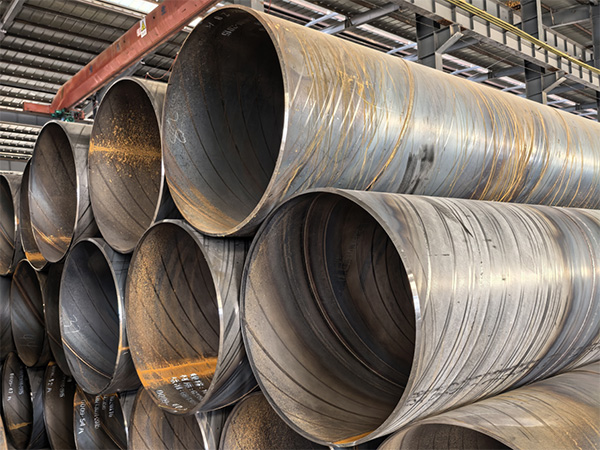
Spiral Welded Pipe for Piling
TAG:Spiral Pipe for Structural Use Spiral Steel Pipe for Bridge Engineering Spiral Pipe for Water Conservancy Project
Spiral Welded Pipe for Piling,also known as SSAW(Spiral Submerged Arc Welded)Pipe Pile,is a premium deep-foundation component manufactured by helically forming hot-rolled high-strength steel coils and applying double-sided submerged arc wel...
Spiral Welded Pipe for Piling,also known as SSAW(Spiral Submerged Arc Welded)Pipe Pile,is a premium deep-foundation component manufactured by helically forming hot-rolled high-strength steel coils and applying double-sided submerged arc welding.Its continuous helical weld seam offers inherent structural advantages over straight-seam pipes,making it a first-choice solution for heavy-duty foundation projects in complex geological and marine environments.
Manufacturing Process&Standards
Production Flow:Uncoiling→Leveling→Edge trimming→Helical forming→Double-sided submerged arc welding→Sizing→Cutting→Non-destructive testing(UT/RT)→Surface treatment&anti-corrosion(coating,galvanizing)→Final inspection&marking.
Key Standards:
International:ASTM A252,API 5L,ISO 3183,AWS D1.1
Chinese:SY/T 5040,GB/T 9711
Typical Specifications:Diameter 325mm–2400mm;Wall thickness 8mm–60mm;Length 6m–12m(custom lengths available for large projects).
Core Advantages
Superior Stress Distribution:The helical weld disperses axial,hoop,and lateral loads more evenly,significantly reducing weld failure risks during pile driving and under long-term service.
High Strength-to-Weight Ratio:Made of Q345(16Mn)and higher-grade high-strength low-alloy steel,enabling thinner walls for the same load capacity,lowering material and transportation costs.
Large Diameter Flexibility:Can be fabricated into large-diameter pipes from narrow coils,with shorter lead times compared to plate-based straight-seam piles.
Strong Corrosion Resistance:Optional anti-corrosion treatments(3PE coating,fusion-bonded epoxy,hot-dip galvanizing)extend service life in coastal/marine and high-moisture soil conditions.
Cost Efficiency:Continuous mass production,less material waste,and simplified on-site splicing cut overall project costs and construction schedules.
Applications
It is widely applied in critical infrastructure projects:
Bridge foundations(viaducts,cross-river/sea bridges)
Deep foundations for high-rise buildings and industrial plants
Port terminals,breakwaters,and offshore platform piles
Retaining walls,slope stabilization,and flood control projects
Wind farm tower foundations(onshore and offshore)