

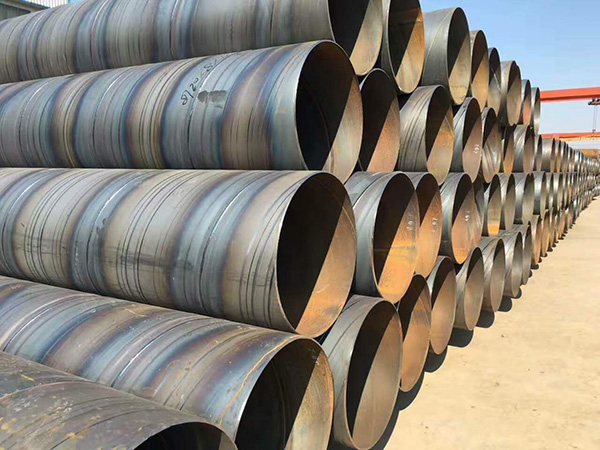
Spiral Steel Pipe
Spiral Steel Pipe is produced by rolling hot-rolled steel strip coils into a cylindrical blank at a spiral angle,followed by double-sided submerged arc welding(SSAW).Key steps:Uncoiling,leveling,edge trimming/milling and surface cleaning of...
Spiral Steel Pipe is produced by rolling hot-rolled steel strip coils into a cylindrical blank at a spiral angle,followed by double-sided submerged arc welding(SSAW).Key steps:Uncoiling,leveling,edge trimming/milling and surface cleaning of steel coils;Spiral forming with precise gap control(1–3 mm);Internal&external submerged arc welding,with Lincoln or equivalent professional welding equipment;Non-destructive testing(X-ray,ultrasonic),hydrostatic pressure test,cutting to length,anti-corrosion coating(3PE,epoxy,FBE).
Material Grades&Specifications
Common material grades for spiral steel pipes include Q235B,Q345B(D),L245,L360,X42–X80,ST37-2,and ST52-3.The outer diameter(OD)range is from 219 mm up to 3600 mm,with large diameter being its biggest advantage over straight seam pipes.The wall thickness is typically 6 mm–25 mm,and can be customized up to 30+mm.The length is usually 12 m,and can be custom-made from 6 m to 18 m.
Key International&Chinese Standards
The main standards applicable to spiral steel pipes include API 5L,which is a global standard for oil&gas transmission pipelines covering PSL1/PSL2 grades;GB/T 9711,the Chinese national standard for oil&gas pipes equivalent to API 5L;SY/T 5037,which is used for common fluid transport such as water,sewage,and low-pressure gas;and EN 10217,the European welded steel pipe standard.
Core Advantages
1.Cost-effective for large diameters:Narrow strips can produce big OD pipes,resulting in lower material waste.2.Uniform stress distribution:The spiral weld disperses axial/radial pressure,providing better anti-deformation performance than straight seam pipes for low–medium pressure lines.3.High production efficiency:Continuous coil feeding enables mass production.4.Strong customization:Flexible options for OD,wall thickness,length and coating.
Main Application Scenarios
Spiral steel pipes are widely used in energy transmission,such as long-distance oil and natural gas pipelines(e.g.,West–East Gas Pipeline);municipal infrastructure,including water supply,sewage treatment,rainwater drainage,and urban gas networks;construction&piling,such as bridge piles,port wharves,and foundation support pipes;and industrial piping,including chemical plants,power plant cooling water,and desalination projects.
Spiral vs.Seamless vs.Straight Seam Pipes
Spiral SSAW pipes have the advantages of large OD,low cost,and good pressure resistance,but are not suitable for ultra-high pressure/temperature scenarios,making them ideal for medium–low pressure large-diameter fluid pipelines and piling.Seamless pipes have no welds and high pressure/temperature resistance,but are high in cost and limited in OD,which are suitable for high-pressure steam,petrochemical refinery,and boiler tubes.Straight Seam LSAW pipes feature fast production for fixed sizes,but have poor stress distribution and limited OD flexibility,making them suitable for short-distance urban pipes and structural pipes.