

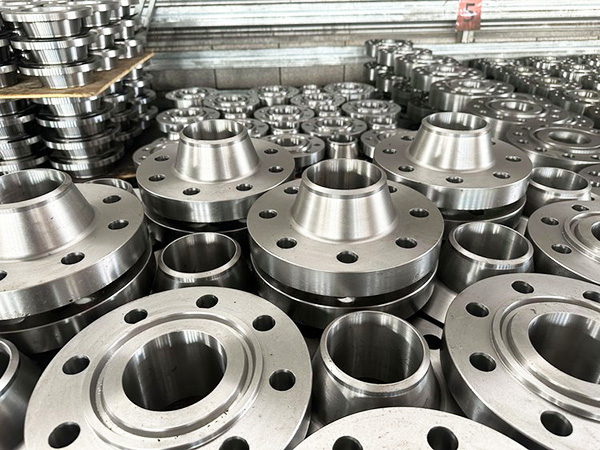
Weld Neck Flange
A Weld Neck Flange(WN Flange),also referred to as a welding neck flange or tapered hub flange,is a premium pipe connection component distinguished by its long,tapered neck(hub)that enables full-penetration butt welding to the pipe end.It is...
A Weld Neck Flange(WN Flange),also referred to as a welding neck flange or tapered hub flange,is a premium pipe connection component distinguished by its long,tapered neck(hub)that enables full-penetration butt welding to the pipe end.It is one of the most reliable flange types for critical,high-pressure,high-temperature,or cyclic service applications in the piping industry.
Design&Key Features
Tapered Hub:The gradual taper from the thick flange body to the pipe wall thickness distributes stress evenly,eliminating sharp stress concentrations at the weld joint and improving fatigue resistance.
Matched Bore:The flange’s internal diameter is machined to match the connected pipe’s ID,creating a smooth,unrestricted flow path that minimizes turbulence,erosion,and pressure drop.
Butt Weld Joint:Requires a full-penetration groove weld,which can be radiographed(RT)for non-destructive examination(NDE),ensuring weld integrity for safety-critical systems.
Sealing Faces:Common options include Raised Face(RF),Flat Face(FF),and Ring Type Joint(RTJ);RTJ is preferred for ultra-high pressure/temperature scenarios.
Manufacturing:Almost exclusively forged(e.g.,ASTM A105 carbon steel,ASTM A182 stainless steel)for structural strength,avoiding plate-cut flanges for critical services.
Standards&Sizes
ASME B16.5(NPS½”to 24”,pressure classes 150–2500)
ASME B16.47(large diameters NPS 26”–60”)
EN 1092-1,DIN,JIS,BS standards for global applications
Applications
Widely used in industries with severe operating conditions:
Oil&gas(upstream,midstream pipelines,refineries)
Petrochemical,chemical processing plants
Power generation(nuclear,thermal,hydro)
High-pressure steam systems,cryogenic lines
Offshore platforms and subsea piping
Advantages&Limitations
Advantages:Exceptional structural integrity;uniform stress distribution;leak-tightness under extreme pressure/temperature/cyclic loading;inspectable full-penetration welds.
Limitations:Higher material and fabrication costs compared to slip-on flanges;requires more precise alignment during installation.