

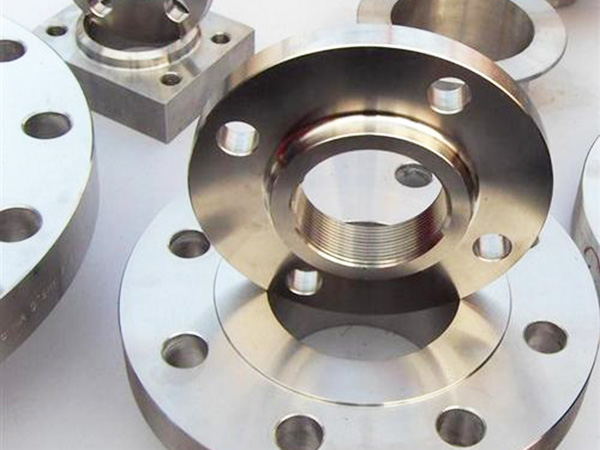
Threaded Flange
A threaded flange is a non-welded pipe connection component featuring a female-threaded bore that mates with the male external threads of a pipe.It consists of a flange disc with bolt holes,a sealing face(commonly Raised Face(RF)or Flat Fac...
A threaded flange is a non-welded pipe connection component featuring a female-threaded bore that mates with the male external threads of a pipe.It consists of a flange disc with bolt holes,a sealing face(commonly Raised Face(RF)or Flat Face(FF)),and a precisely machined tapered or parallel thread(typically NPT per ASME B1.20.1,BSP,or API standards).It screws directly onto the pipe end,eliminating the need for welding—critical for explosive,flammable,or heat-sensitive environments.Final sealing is achieved by tightening the flange bolts with a gasket between two mating flanges;optional seal welding can be applied for enhanced leak protection if conditions allow.
Key Specifications&Materials
Standards:ASME B16.5,EN 1092-1,API 6A,BS 10
Size Range:Typically preferred for small diameters(1/2”to 4”/DN15–DN100);available up to 24”(DN600)but less common for larger sizes
Pressure Ratings:Class 150,300,600,900,1500,2500;PN10,PN16,PN25,PN40
Materials:Carbon steel(ASTM A105),stainless steel(304/316,ASTM A182),alloy steel,duplex stainless steel,bronze,galvanized steel
Thread Types:NPT(tapered,most common in North America),BSPT(tapered),BSPP(parallel,Europe/Asia)
Advantages
No Welding Required:Eliminates fire hazards,sparks,and welding-related material embrittlement;ideal for Ex-rated zones,offshore,and maintenance-intensive systems
Quick Installation&Disassembly:Enables faster pipe modifications,inspections,and replacements
Lower Labor Costs:No need for certified welders or post-weld heat treatment(PWHT)
Minimal Pipe Wall Damage:No heat-affected zones(HAZ)compared to welded flanges
Limitations
Size&Pressure Restrictions:Less suitable for large diameters(>4”)or high-temperature/high-cycle applications(thread distortion risks leakage)
Thread Integrity Dependence:Contamination,cross-threading,or thread damage can lead to leaks
Not for Thin-Wall Pipes:Insufficient wall thickness to machine robust external threads
Typical Applications
Oil&Gas(upstream wellheads,gathering lines,refinery utility systems)
Chemical Processing(flammable liquid/gas lines,corrosive media with non-weld constraints)
Water Treatment,Fire Protection,and HVAC systems
Instrumentation and compressed air lines
Marine,offshore platforms,and hazardous-area industrial facilities
Installation Tips
Ensure pipe threads are clean,undamaged,and conform to the same standard as the flange
Apply anti-seize compound or thread sealant(PTFE tape,anaerobic sealant)to prevent leaks and galling
Hand-tighten first,then use a torque wrench to achieve uniform bolt loading;avoid over-tightening
Inspect the flange face and gasket for debris before assembly
For critical services,consider seal welding the thread junction after initial assembly