

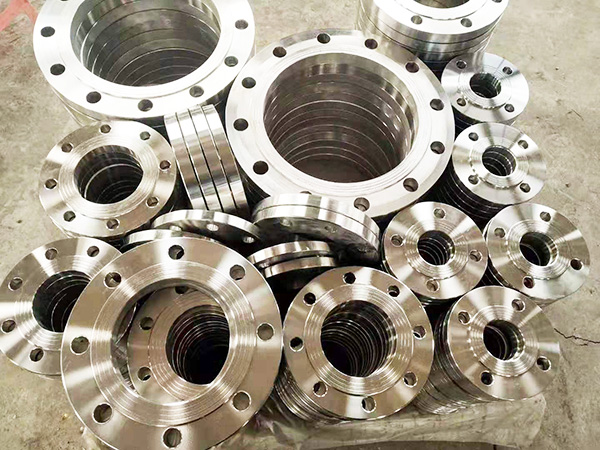
Stainless Steel Flange
Stainless steel flanges are essential,disc-shaped mechanical connectors in industrial and commercial piping systems,designed to join pipes,valves,pumps,tanks,and other process equipment reliably.A typical flange connection consists of two m...
Stainless steel flanges are essential,disc-shaped mechanical connectors in industrial and commercial piping systems,designed to join pipes,valves,pumps,tanks,and other process equipment reliably.A typical flange connection consists of two mating flanges,a sealing gasket,and high-tensile bolts/nuts—enabling detachable,leak-proof joints that simplify system inspection,maintenance,and component replacement.
Crafted from iron-chromium-nickel alloys,stainless steel flanges form a passive chromium oxide layer on their surface,which self-heals when damaged.This inherent feature delivers exceptional corrosion resistance,outperforming carbon steel counterparts in aggressive environments with acids,alkalis,saltwater,and high humidity.They also exhibit outstanding mechanical strength,temperature tolerance(ranging from cryogenic conditions to high-heat industrial processes),and long service life with minimal upkeep.
Common Types&Their Applications
Weld Neck(WN)Flange:Features a long tapered hub for optimal stress distribution.Ideal for high-pressure,high-temperature systems(oil&gas,power plants,petrochemicals).Welded to the pipe for maximum structural integrity.
Slip-On(SO)Flange:Pipes slip into the flange bore,with fillet welds on both sides.Cost-effective,easy to install,suited for low-to-medium pressure applications(water treatment,HVAC,general industrial piping).
Socket Weld(SW)Flange:For small-bore,high-pressure lines.Pipe inserts into a socket,welded externally;excellent alignment for instrumentation and chemical processing systems.
Threaded(TH)Flange:No welding required—connected via NPT or BSP threads.Perfect for systems where welding is restricted(hazardous areas,small-diameter utility lines).
Blind Flange:Solid disc used to seal pipe ends,pressure vessels,or unused nozzles.Critical for isolation during maintenance.
Popular Material Grades
304/304L:General-purpose,cost-efficient;ideal for water,food,pharmaceutical,and mild chemical applications.304L has lower carbon content for better weldability and reduced intergranular corrosion risk.
316/316L:Contains molybdenum,offering superior resistance to chlorides and harsh chemicals.Widely used in marine,coastal,chemical processing,and desalination projects.316L is the preferred choice for ultra-corrosive environments.
Duplex 2205:Combines the strength of ferritic steel and corrosion resistance of austenitic steel,suitable for high-pressure,high-corrosion offshore and petrochemical operations.
International Standards
Compliance with global standards ensures interchangeability across projects and regions:
ASME B16.5:For North American markets,standard pipe sizes and pressure classes.
DIN EN 1092-1:European standard,widely adopted in the EU and Middle East.
JIS B2220:Japanese industrial standard,common in Asia-Pacific countries.
Key Application Industries
Stainless steel flanges are found across diverse sectors:Oil&Gas(onshore/offshore pipelines,refineries),Chemical Processing(acid/alkali transfer),Food&Beverage(sanitary processing lines),Pharmaceuticals(GMP-compliant systems),Water&Wastewater Treatment,Power Generation,Marine Engineering,and HVAC.
Installation&Maintenance Tips
Clean flange faces thoroughly to remove debris,rust,or old gasket residue before assembly.
Select the correct gasket material(PTFE,graphite,rubber)based on the medium,temperature,and pressure.
Tighten bolts in a crisscross,stepwise pattern to ensure uniform clamping force and prevent leaks.
Regularly inspect for signs of corrosion,gasket degradation,or bolt loosening,especially in critical service lines.