

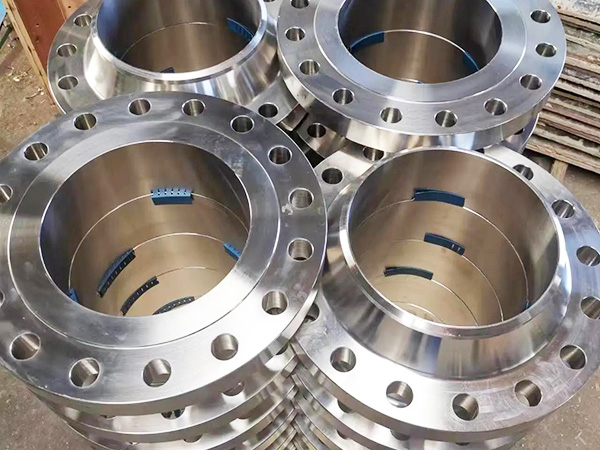
Socket Weld Flange
A Socket Weld Flange(SW Flange)is a type of pipe flange that connects to pipe ends via an internal socket bore(a recessed hole)rather than a butt weld.The pipe is inserted into the socket,and a fillet weld is made around the outside of the...
A Socket Weld Flange(SW Flange)is a type of pipe flange that connects to pipe ends via an internal socket bore(a recessed hole)rather than a butt weld.The pipe is inserted into the socket,and a fillet weld is made around the outside of the flange and pipe to form a secure,leak-tight connection.It is widely used for small-bore piping in high-pressure,high-temperature,and critical service applications.
Design&Key Features
Socket Bore Design:The flange’s inner diameter is machined to create a precise socket that accepts the pipe.This allows for easy insertion and alignment,eliminating the need for complex butt weld preparation.
Fillet Weld Connection:The connection is made by welding the outside of the flange to the outside of the pipe.This fillet weld distributes stress around the joint and provides a strong seal.
Thicker Flange Body:Compared to slip-on flanges,socket weld flanges have a thicker flange body,which enhances their structural integrity and pressure rating.
Smooth Bore Transition:The socket bore is designed to match the pipe’s outer diameter,ensuring a smooth flow path when the pipe is fully inserted.
Self-Centering:The socket bore ensures the pipe is centered within the flange,promoting balanced stress distribution and reducing the risk of weld defects.
Standards&Sizes
ASME B16.5:For NPS½”to 24”(pressure classes 150–2500).
ASME B16.47:For large diameters(NPS 26”–60”).
EN 1092-1:European standard.
Common Materials:A105 carbon steel,A182 F304/F316 stainless steel,alloy steel.
Applications
Ideal for small-bore(typically NPS≤4”)piping systems in industries such as:
Oil&Gas:Instrument lines,sample lines,and utility lines.
Petrochemical&Chemical Processing:High-pressure lines for corrosive or hazardous fluids.
Power Generation:Steam and boiler feed lines.
Refineries:Piping for various process units.
Plumbing&HVAC:High-pressure water and steam lines in commercial and industrial buildings.
Advantages&Limitations
Advantages
Easy Installation:The socket bore simplifies alignment and speeds up the welding process compared to butt weld flanges.
Strong Joint:The fillet weld provides a reliable and leak-tight connection,especially for high-pressure applications.
Cost-Effective:Generally more cost-effective than butt weld flanges for small-bore applications.
Good for Hard-to-Weld Areas:Useful in confined spaces where butt welding is difficult.
Limitations
Not for High-Cycle Applications:The stress concentration at the fillet weld makes it less suitable for applications with frequent pressure or temperature cycling.
Limited to Small Bores:Primarily used for small-diameter pipes(NPS≤4”).
Weld Inspection Challenges:The internal socket makes it harder to inspect the root weld,which may require advanced non-destructive examination(NDE)techniques.