

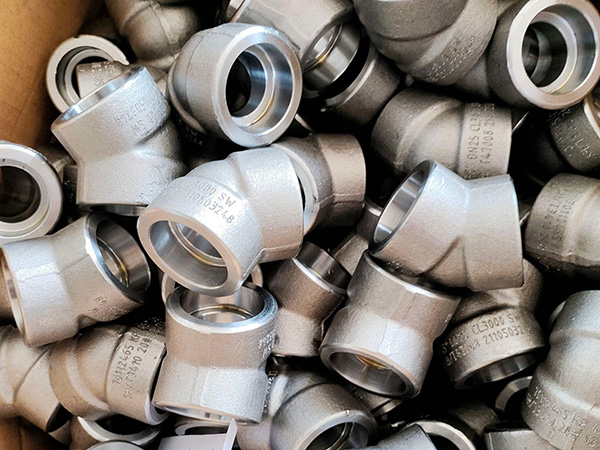
Forged Elbow
A Forged Elbow is a premium,heavy-duty pipe fitting manufactured via hot/cold forging processes,designed specifically to change the direction of fluid or gas flow in industrial piping networks.Unlike cast or seamless elbows,forging compacts...
A Forged Elbow is a premium,heavy-duty pipe fitting manufactured via hot/cold forging processes,designed specifically to change the direction of fluid or gas flow in industrial piping networks.Unlike cast or seamless elbows,forging compacts the metal grain structure,resulting in exceptional density,tensile strength,impact resistance,and resistance to fatigue—making it the first choice for high-temperature,high-pressure(HTHP),and safety-critical applications.
Types&Configurations
Angle Options:45°,90°(most common),and 180°(return bend)elbows.
Radius:Short Radius(SR,1.0×Nominal Diameter)and Long Radius(LR,1.5×Nominal Diameter)to suit space constraints and flow requirements.
Connection Methods:
Socket Weld(SW):For small-bore,high-pressure lines(per ASME B16.11).
Threaded(NPT,BSP):Quick installation,no welding needed for certain systems.
Butt Weld(BW):For larger diameters and ultra-high-pressure applications(ASME B16.9).
Pressure Ratings:Class 2000,3000,6000,9000 psi(standard for forged fittings).
Materials&Standards
Common Materials:Carbon steel(ASTM A105,A234 WPB),alloy steel(A234 WP11/WP22),stainless steel(ASTM A182 F304,F316,F316L),duplex/super duplex steels.
Key Standards:ASME B16.11(forged socket-weld/threaded fittings),ASME B16.9(butt-weld fittings),ASTM A234,ASTM A182,MSS SP-79,EN 10241,JIS B2316.
Manufacturing Process
Billet Heating:Metal billets are heated to a high temperature(below melting point)to improve ductility.
Forging:Using presses/hammers to shape the billet into the elbow form;hot forging is standard for high-pressure grades.
Machining:Precision turning,threading,or beveling to meet dimensional tolerances.
Heat Treatment:Normalizing,quenching,tempering to optimize mechanical properties.
Non-Destructive Testing(NDT):Ultrasonic Testing(UT),Magnetic Particle Inspection(MPI),Liquid Penetrant Testing(LPT),Hydrostatic Testing to ensure zero defects.
Applications
Forged elbows are indispensable in industries where failure is not an option:
Oil&Gas(upstream exploration,refineries,pipelines).
Petrochemical plants and chemical processing facilities.
Power generation(nuclear,thermal,and combined-cycle power plants).
Pharmaceutical and food processing(stainless steel variants for hygiene).
Shipbuilding,offshore platforms,and high-pressure industrial fluid systems.
Advantages
Superior Strength:Forged grain structure eliminates porosity and internal cracks.
High Durability:Resists creep,corrosion,and wear in extreme environments.
Tight Tolerances:Precision machining ensures leak-proof connections and compatibility with global piping standards.
Long Service Life:Reduces maintenance costs and downtime in critical systems.