

Welded steel pipe appears in more industrial applications than any other tubular product form. The global welded pipe market serves oil and gas transmission, municipal water distribution, structural construction, mining, power generation, and countless manufacturing processes. Each application places different demands on the pipe—pressure capability, diameter, wall thickness, corrosion resistance, and structural strength—and the welded pipe industry has developed specialized production capabilities to serve each of these markets. Understanding where welded steel pipe applications cluster helps procurement professionals match pipe type to application requirements rather than defaulting to generic specification that may over- or under-serve the actual need.
Oil and Gas Transmission: The Largest Single Market
Pipeline transmission of crude oil, natural gas, and refined products represents the largest-volume application for welded steel pipe. Long-distance transmission pipelines—spanning hundreds to thousands of kilometers—require large-diameter, heavy-wall pipe capable of sustaining internal pressure over multi-decade design lives. This is the domain of LSAW and, for larger diameters, SSAW production.
LSAW pipe dominates high-pressure transmission pipeline applications in diameters from NPS 16 through NPS 48. API 5L Grade X52 through X70, in PSL 2 quality level, serves the majority of new pipeline construction. The longitudinal weld seam provides straightforward stress analysis under internal pressure, and the UOE forming and expansion process achieves the dimensional precision that field construction tolerances require. For offshore subsea pipelines, LSAW pipe with enhanced testing and documentation serves the demanding requirements of underwater installation and operation.
SSAW pipe competes in the same large-diameter transmission market, particularly for diameters above NPS 30 where the spiral forming process offers material economics that LSAW plate-based production cannot match. The spiral weld seam's angled orientation relative to hoop stress creates a more complex stress analysis than LSAW's longitudinal seam, but modern SSAW production achieves quality levels that satisfy most transmission pipeline specifications. The choice between LSAW and SSAW for a given pipeline project often follows from diameter, project volume, and the pipe mill's production capability.
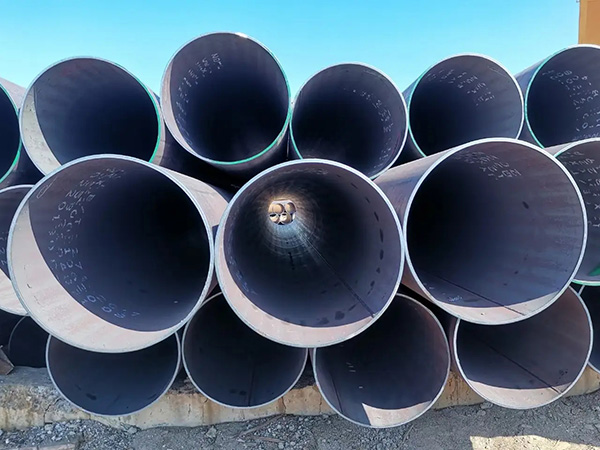
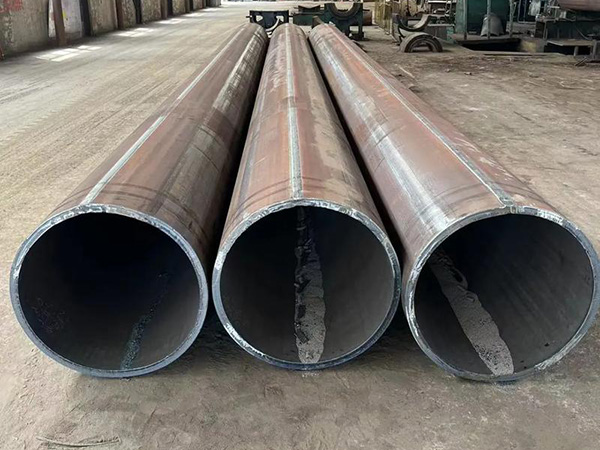
For smaller-diameter oil and gas gathering lines and distribution systems, ERW pipe serves applications that do not require the heavy walls or large diameters of transmission pipeline. Gathering lines—NPS 4 through NPS 12, typically operating at moderate pressures—connect wellhead production to processing facilities. ERW pipe produced to API 5L PSL 2 provides adequate performance for non-sour, non-critical gathering service where the pressure requirements and failure consequences do not demand seamless or LSAW construction.
In natural gas distribution networks, ERW pipe in NPS 2 through NPS 12 serves the low to moderate pressure mains and service lines that deliver gas to residential, commercial, and industrial customers. ASTM A53 and AGA (American Gas Association) standards govern the materials and testing requirements for distribution applications. The large installed base of ERW pipe in gas distribution systems reflects decades of reliable service in the moderate-pressure range where ERW provides the best balance of cost and performance.
Water and Wastewater Infrastructure
Municipal water transmission and distribution represents another major category of welded steel pipe applications. Large-diameter water transmission mains—often NPS 24 through NPS 72 or larger—transport drinking water from treatment facilities to distribution networks. LSAW and SSAW pipe, often with cement mortar lining for internal corrosion protection and external polyethylene or tape coating for soil corrosion resistance, serve these long-lived infrastructure assets.
Water transmission pipelines typically operate at lower pressures than oil and gas transmission lines, which can allow lighter wall specifications—but the consequence of failure is equally severe, since a water main rupture can cause flooding, infrastructure damage, and loss of service to large populations. The specification of water pipeline materials balances pressure capability, corrosion protection, hydraulic efficiency (smooth internal surfaces minimize pressure loss), and the 50-plus-year design life that municipal infrastructure demands.
Wastewater and sewage collection systems present additional challenges due to the corrosive nature of sewage gases and the abrasive characteristics of solid transport. Fusion-bonded epoxy coating, polyethylene encasement, and cathodic protection extend the service life of welded steel pipe in these aggressive environments.
Structural and Construction Applications
Beyond fluid transmission, welded steel pipe serves structural applications where its tubular cross-section provides efficient load-carrying capability. ASTM A500 covers cold-formed welded carbon steel structural tubing in round, square, and rectangular shapes—the section geometry that architects and structural engineers select for its strength-to-weight ratio, fire resistance, and aesthetic characteristics.
Common structural welded steel pipe applications include building columns and beams, where tubular sections carry axial and bending loads in commercial and industrial structures. Bridge piers and supports use tubular steel sections to resist compression and lateral loads. Offshore platform legs and braces depend on the combination of high strength and corrosion resistance that tubular members provide. Moment frames and braced frames in seismic zones use tubular members because the closed section provides uniform stiffness in all directions and eliminates the weak-axis buckling concerns of open I-section members.
Piling applications use welded steel pipe—often uncoated or with concrete fill—to transfer structural loads to deep bearing strata. The combination of high axial load capacity, ease of installation through driving or drilling, and the ability to extend to great depths makes welded pipe piling economical for building foundations, bridge supports, and marine structures.
Mining and Resources Processing
The mining industry uses welded steel pipe across slurry pipelines, process piping, and dewatering systems. Slurry pipelines—transporting ore concentrates, tailings, and other abrasive mixtures—demand thick-wall pipe with abrasion-resistant properties. LSAW pipe in heavy wall configurations, often with internal wear liners or hard-facing, serves these demanding transport applications where the abrasive particles erode pipe walls over time.
Process piping in mineral processing facilities connects tanks, pumps, and reactors in circuits that handle corrosive process streams. The specification of welded pipe in these applications follows the same principles as general industrial process piping—matching corrosion resistance to the process chemistry, pressure capability to the operating conditions, and wall thickness to the abrasion and erosion environment.
Power Generation and Energy
Power plant construction uses welded steel pipe across multiple systems: feedwater piping, condensate return, cooling water circuits, and steam piping in moderate-temperature service. ASTM A53 and A106 serve general utility piping; heavier-wall A333 grades serve low-temperature condensate return in northern climates.
For coal, gas, and biomass power plants, large-diameter ducts and breechings that convey combustion air and flue gas use welded steel plate construction. These applications are not pipe in the traditional sense—they are fabricated plate structures—but the welded manufacturing principles and material specifications follow the same framework as large-diameter welded pipe.
Selecting the Right Welded Pipe Type for Your Application
Matching welded pipe type to application requires evaluating several factors simultaneously:
Diameter: ERW for NPS 2 to NPS 24; LSAW for NPS 16 and above for high-pressure; SSAW for NPS 12 and above for moderate-pressure large diameters
Pressure requirement: Higher design pressures require heavier walls and more rigorous testing, favoring LSAW for large diameters
Service environment: Corrosive media, abrasive slurries, or buried installation require coating, lining, or cathodic protection in addition to base material selection
Size consistency: Projects requiring tight dimensional tolerances benefit from UOE-formed LSAW with mechanical expansion
Testing and certification: Critical applications (high-pressure gas, offshore, sour service) require PSL 2, enhanced NDE, and comprehensive documentation
Available inventory: Standard ERW and LSAW sizes may be available from stock; non-standard sizes require mill production with extended lead times
Conclusion
Welded steel pipe applications span virtually every industrial sector, from long-distance transmission pipelines to building columns, from municipal water mains to mining slurry circuits. The three primary pipe types—ERW, LSAW, and SSAW—each occupy distinct positions in this application landscape based on their manufacturing characteristics, dimensional ranges, and performance capabilities. ERW dominates medium-diameter moderate-pressure applications. LSAW serves large-diameter, high-pressure transmission and structural applications. SSAW provides economical large-diameter pipe for moderate-duty transmission and infrastructure.
For engineers and procurement professionals, the key is matching the pipe type to the actual application requirements rather than defaulting to habit or generic specification. Projects that specify the correct pipe type—based on diameter, pressure, environment, and consequence of failure—consistently achieve better cost outcomes than those that over-specify uniformly or accept whatever pipe type the supplier delivers by default. When specification uncertainty exists, consulting with a manufacturer who serves multiple pipe type markets provides the perspective needed to optimize the selection.
FAQ
Q: What welded pipe type is best for natural gas distribution?
A: ERW pipe in NPS 2 through NPS 12, produced to API 5L or ASTM A53 requirements, serves the majority of natural gas distribution applications. For large-diameter distribution mains above NPS 16, LSAW or SSAW pipe with appropriate coating provides the diameter and pressure capability that trunk and transmission distribution requires. The specific grade and PSL level follow from the operating pressure and applicable code requirements.
Q: Can ERW pipe be used for offshore pipeline applications?
A: ERW pipe is generally not specified for offshore applications where external hydrostatic pressure, installation stress, and fatigue loading create demanding multi-axis stress states. LSAW pipe, with its longitudinal seam and verified weld quality, is the standard for offshore pipelines. The weld seam orientation and testing requirements for offshore service are more rigorous than ERW production typically meets.
Q: What welded pipe is used for structural building columns?
A: ASTM A500 Grade B or C, typically in round, square, or rectangular sections, serves structural building applications. This specification covers cold-formed welded and seamless structural tubing with yield strengths of 42,000 to 50,000 PSI. The choice between welded and seamless follows from availability, size, and the structural engineer's requirements for the specific application.
Q: How do I determine whether LSAW or SSAW is better for a pipeline project?
A: For high-pressure transmission above approximately 1,440 PSI, LSAW is typically preferred due to its simpler weld seam stress analysis and tighter dimensional tolerances. For moderate-pressure water or slurry pipelines, SSAW often provides economic advantage through flexible diameter production from standard coil widths. Consult the project's engineering specifications and applicable code requirements to determine which pipe type is acceptable for the specific service conditions.
Q: What coating is typically specified for buried welded steel pipe?
A: Common burial coatings include: fusion-bonded epoxy (FBE) for general buried service, three-layer polyethylene (3LPE) for aggressive soil environments, polyethylene encasement (slip-on polyethylene sheet) for cast-iron soil pipe legacy systems, and cement mortar lining for water transmission to prevent internal corrosion and maintain hydraulic efficiency. The coating selection should match the soil corrosion environment and the design life requirements.
References
American Petroleum Institute. (2024). API Spec 5L, 47th Edition: Specification for Line Pipe. Washington, DC.
ASTM International. (2024). ASTM A53/A53M-24: Standard Specification for Pipe, Steel, Black and Hot-Dipped, Zinc-Coated, Welded and Seamless. West Conshohocken, PA.
ASTM International. (2024). ASTM A500/A500M-24: Standard Specification for Cold-Formed Welded and Seamless Carbon Steel Structural Tubing. West Conshohocken, PA.
American Society of Mechanical Engineers. (2022). ASME B31.8: Gas Transmission and Distribution Piping Systems. New York, NY.
American Water Works Association. (2023). AWWA C200: Steel Water Pipe—Manufacturing. Denver, CO.