

Selecting between thin wall seamless steel pipe and thick wall seamless steel pipe represents one of the most consequential decisions in industrial tubular procurement. Wall thickness directly governs pressure capacity, weight, material cost, and fabrication flexibility—factors that compound across project scale. This comparison equips B2B procurement professionals with the analytical framework needed to specify the optimal wall profile for each application, balancing performance requirements against total installed cost.
Defining Wall Thickness Categories
Wall thickness classification follows the diameter-to-wall ratio (D/t). Thin wall pipe generally exhibits D/t ratios above 25, while thick wall classifications fall below 15-20. In practical specification terms, thin wall corresponds to Schedule 5, 10, and 20 designations, whereas thick wall encompasses Schedule 80, 120, 160, and XXH grades across standard nominal pipe sizes.
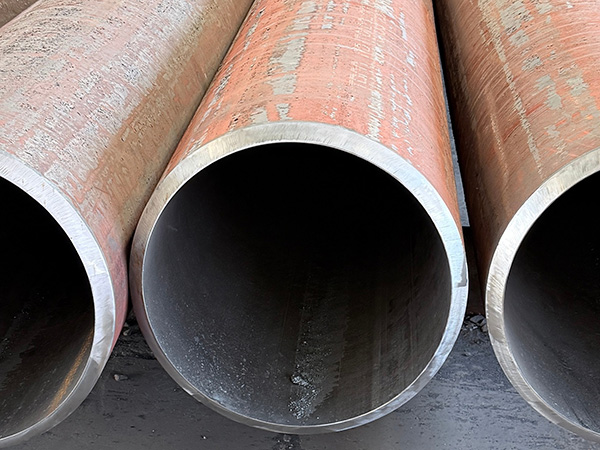
The same nominal diameter can be supplied in both thin and thick wall versions, with wall thickness ranging from approximately 1.65mm (Schedule 5) to over 30mm (Schedule 160) for a 6-inch pipe. This flexible geometry enables engineers to match material precisely to required performance envelopes without altering connection standards.
Structural and Pressure Performance
Wall thickness dictates hoop stress behavior per Barlow's formula, where pressure capacity scales linearly with wall thickness and inversely with diameter. Thick wall seamless steel pipe delivers substantially higher burst pressure thresholds—Schedule 160 can withstand 3 to 5 times the internal pressure of equivalent Schedule 40 pipe at identical diameters. Thin wall constructions prioritize weight reduction and material economy over extreme pressure containment.
External load resistance follows the same pattern. Thick wall sections resist buckling, crushing, and bending moments far more effectively, with critical buckling pressure scaling approximately with wall thickness cubed. Thin wall products exhibit lower section modulus and require external support or casing when subjected to significant external loads.
Weight and Handling Considerations
Weight scales directly with wall thickness, creating material and logistics implications. Thin wall seamless steel pipe reduces total project weight by 30-60% compared to thick wall equivalents at the same diameter, lowering transportation costs, simplifying rigging, and reducing structural support requirements.
For overhead installations, mobile equipment, and weight-sensitive structures, thin wall profiles deliver decisive advantages. Conversely, heavy wall pipe contributes mass that can benefit vibration damping and thermal stability in fixed process installations where weight is not a constraint.
Material Cost and Fabrication Economics
Material cost correlates with wall thickness—thick wall pipe consumes substantially more raw steel per linear foot. However, procurement decisions must account for total installed cost rather than material price alone.
Thin wall products offer lower base material cost but may require more frequent supports, thicker corrosion allowances in aggressive service, and careful handling to prevent deformation. Thick wall products command premium pricing yet reduce support frequency, extend service life in erosive conditions, and tolerate field machining or threading operations without compromising minimum wall.
Fabrication differences are notable: thin wall pipe bends and forms more readily with lower force requirements, while thick wall sections demand mandrel bending or hot-forming techniques and longer weld preparation times. Welding thin wall joints requires controlled heat input to prevent burn-through, whereas thick wall welds need preheat, interpass temperature control, and post-weld heat treatment per procedure specifications.
Corrosion Allowance and Service Life
In corrosive environments, wall thickness doubles as corrosion allowance. Thick wall seamless steel pipe provides built-in material reserve, extending service life in erosive or chemically aggressive service without supplemental linings. Thin wall constructions require protective coatings, linings, or corrosion-resistant alloy upgrades to achieve comparable longevity.
Process industries handling abrasive slurries or aggressive chemicals frequently specify heavy wall carbon steel to absorb years of uniform corrosion, whereas thin wall stainless or alloy grades serve clean, low-corrosion process streams where weight savings and flow efficiency dominate priorities.
Application Guidance by Sector
Thin wall seamless pipe suits architectural handrails, lightweight structural frames, low-pressure fluid transfer, heat exchanger tubing, and automotive exhaust systems where weight and cost drive design. Thick wall seamless steel pipe serves high-pressure hydraulics, downhole oilfield strings, boiler and steam headers, pressure vessel nozzles, and structural piling where strength and integrity margins are paramount.
Matching wall profile to duty cycle prevents both over-engineering—which inflates cost and weight—and under-specification, which risks premature failure. Engineering calculations per ASME B31.3 establish minimum required wall including allowances for pressure, mechanical loads, and corrosion.
Decision Framework for Procurement
B2B buyers should evaluate these parameters sequentially:
Design pressure and temperature — establishes minimum required wall via code formulas
External loads — buried, traffic, or thermal forces may demand heavy wall
Corrosion rate — projected loss over design life becomes required allowance
Weight constraints — overhead or mobile applications favor thin wall
Fabrication plan — bending, threading, and welding methods vary by wall
Total installed cost — material, support, handling, and lifecycle expenses
When duty permits, thin wall selection maximizes economy and handling efficiency. When margins matter, thick wall investment pays through reliability and extended service intervals.
Conclusion
The choice between thin wall seamless steel pipe and thick wall seamless steel pipe is not about superiority but fit. Thin wall excels where weight, cost, and fabricability dominate; thick wall delivers where pressure, load, and longevity govern. Procurement professionals who anchor decisions in code-based wall calculations—rather than generalized preference—secure optimal technical and economic outcomes.
Document the engineering basis for wall selection in project specifications, validate against ASME design equations, and confirm supplier capability for the chosen profile. This disciplined approach eliminates both costly over-specification and dangerous under-specification across industrial piping programs.
Frequently Asked Questions
Q: How do I determine the minimum wall thickness for my application?
A: Apply ASME B31.3 formula t = (P × D) / (2 × S × E × W + 2 × P × Y), incorporating design pressure, outside diameter, allowable stress, weld joint factor, and corrosion allowance. Add mechanical and corrosion allowances to the calculated pressure wall, then select the nearest commercial schedule meeting or exceeding the result.
Q: Can thin wall seamless pipe handle high pressure if the diameter is small?
A: Yes. Because pressure capacity scales with wall-to-diameter ratio, small-diameter thin wall pipe can achieve meaningful pressure ratings. However, extremely high pressures still favor thick wall profiles for safety margin, buckling resistance, and field machinability. Evaluate each combination through code calculation.
Q: Does thick wall pipe always last longer than thin wall pipe?
A: Not automatically. In clean, low-corrosion service, a thin wall stainless line may outlast a thick wall carbon steel line exposed to aggressive media. Wall thickness extends life primarily by providing corrosion allowance and structural reserve—benefits realized only when the base material suits the environment.
Q: Which wall profile is easier to install in the field?
A: Thin wall pipe is lighter, easier to lift, and simpler to bend or form, reducing handling equipment needs. Thick wall pipe requires heavier rigging, preheat for welding, and controlled cool-down, increasing labor and schedule. The trade-off is that thick wall tolerates more aggressive field machining and threading.
Q: Are there standards that limit how thin or thick seamless pipe can be?
A: ASME B36.10M and B36.19 define standard wall schedules from Schedule 5S through XXS, establishing minimum manufacturable and commercially available walls per nominal size. Mill capability and order quantity also constrain extremes; very thin or very heavy walls may require custom production runs with extended lead times.
References
American Society of Mechanical Engineers. (2023). ASME B31.3-2022: Process Piping. New York, NY.
American Society of Mechanical Engineers. (2022). ASME B36.10M-2022: Welded and Seamless Wrought Steel Pipe. New York, NY.
ASTM International. (2024). ASTM A106/A106M-24: Standard Specification for Seamless Carbon Steel Pipe for High-Temperature Service. West Conshohocken, PA.
Smith, R.L. (2024). "Wall Thickness Optimization in Process Piping Systems." Journal of Pressure Vessel Technology, 146(3), 031501.
Chen, W. & Anderson, J. (2025). "Corrosion Allowance Strategies for Industrial Carbon Steel Piping." CORROSION Journal, 81(2), 188-204.